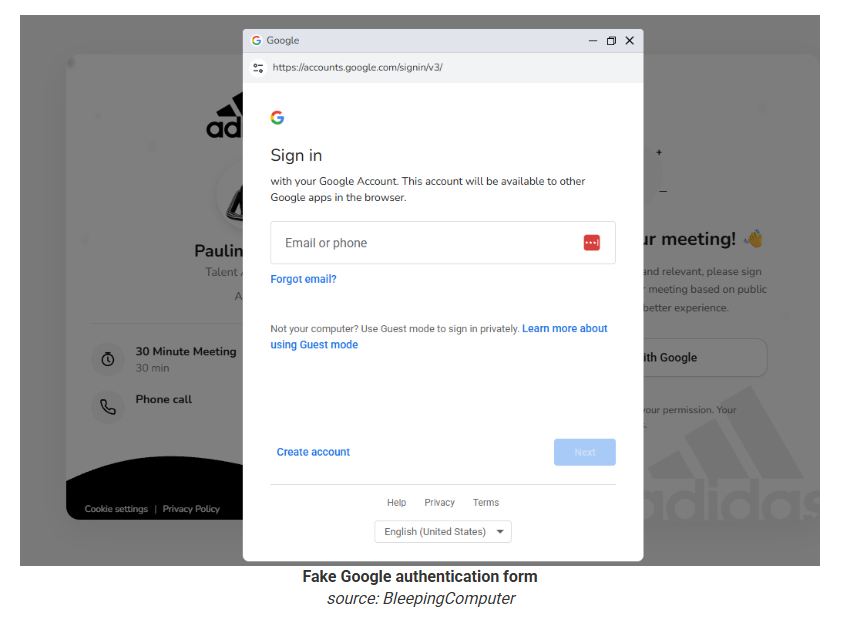
Fake Netflix, Coca-Cola, and FIFA job scams target marketers
A fake recruiter phishing campaign uses trusted brands, nested redirects, and fake Google prompts to steal accounts.
A fake recruiter phishing campaign uses trusted brands, nested redirects, and fake Google prompts to steal accounts.
Proofpoint researchers said attackers targeted physics and engineering departments, and warn that the campaign is likely ongoing. The post Suspected Chinese espionage group used a Roundcube exploit ch
The AI agent didn’t accomplish every step in the late June 2026 attack, but it allowed the threat actor to significantly reduce complexity, speed up the tempo and gain operational advantages. The post
For the latest discoveries in cyber research for the week of 6th July, please download our Threat Intelligence Bulletin. TOP ATTACKS AND BREACHES River Bank & Trust, a US financial institution, ha
Two new campaigns show how cybercriminals are increasingly relying on social engineering instead of software exploits to compromise devices and accounts.
Last week, there were disclosed in and that have been added to the Wordfence Intelligence Vulnerability Database, and there were that contributed to WordPress Security last week. Review those vulnerab
A year ago a researcher found a vulnerability in Apple's Hide My Email feature and now he's tired of waiting for a fix.
We uncovered ClickFix attacks using fake Google and Cloudflare pages to deliver everything from infostealers to a newly discovered malware loader.
Research by: Alexey Bukhteyev Key Takeaways Introduction Over the past several years, large language models have reshaped software development, and malware development has followed the same path.
From outsourced labor to tiered pricing models, an inside look at how today's top ransomware threats operate less like rogue hackers and more like Fortune 500 companies. The post How ransomware syndic
Interesting research on a new class of weak RSA keys: keys with lots of zeros. It turns out that these keys are out in the wild. The badkeys project is an open-source service that checks public keys f
Microsoft has removed over 100 Edge extensions that were delivering malware hidden in images.
For the latest discoveries in cyber research for the week of 29th June, please download our Threat Intelligence Bulletin. TOP ATTACKS AND BREACHES Polymarket, a large cryptocurrency-based prediction m
Kaspersky researchers analyze incidents related to The Gentlemen RaaS group, disclose their tools and TTPs, and find a new ransomware variant.
Analysis of CVE-2024-2658 as found in Schneider Electric's Floating License Manager. Discover how this FlexNet Publisher vulnerability potentially allows attackers to escalate to NT AUTHORITY\SYSTEM p
A phishing campaign installs a malicious Chrome extension to hijack browser sessions and compromise Windows devices.
Last week, there were disclosed in and that have been added to the Wordfence Intelligence Vulnerability Database, and there were that contributed to WordPress Security last week. Review those vulnerab
Mandiant detailed the incident in a blog post Wednesday, but it’s unclear who was behind it or if they managed to get broad visibility into the victim’s internal traffic. The post Malicious hackers ex
Microsoft, with law enforcement and industry partners, disrupted more than 200 command and control servers for Amadey and StealC, often used in conjunction. The post In a first, a court takedown goes
At least one malware developer is adding text about nuclear and biological weapons to their spyware, in an effort to stop automatic AI analysis. Details : The _index.js payload begins with a large Jav