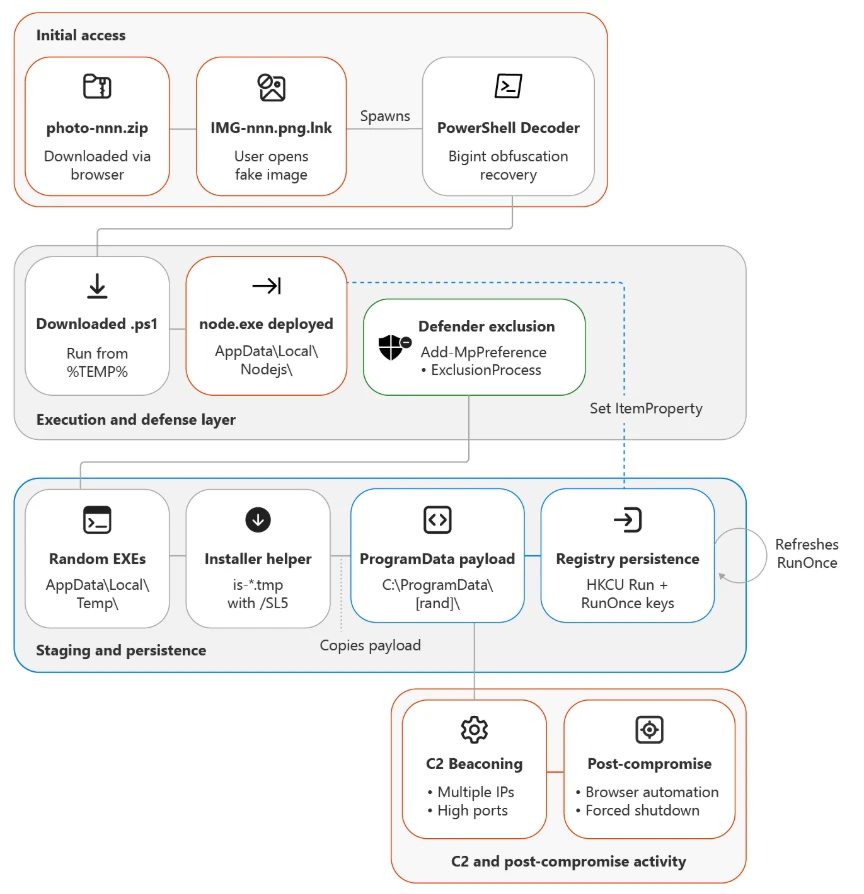
Kimsuky targets organizations with PebbleDash-based tools
Kaspersky researchers analyze a range of new PebbleDash-based tools used in recent Kimsuky campaigns and reveal their connection to the AppleSeed malware cluster.
Key Points Introduction The Gentlemen ransomware‑as‑a‑service (RaaS) operation is a relatively new group that emerged around mid‑2025. Its operators advertise the service across multiple underground f
Go’s native fuzzing is useful, but it stands far behind state-of-the-art tooling that the Rust, C, and C++ ecosystems offer with LibAFL and AFL++. Path constraints are hard to solve. Structured
For the latest discoveries in cyber research for the week of 11th May, please download our Threat Intelligence Bulletin. TOP ATTACKS AND BREACHES Instructure, the US education technology company behin
Key Findings Ransomware in Q1 2026: Consolidation at Scale During the first quarter of 2026, we monitored more than 70 active data leak sites (DLS) that collectively listed 2,122 new victims. This fig
We recently added a C/C++ security checklist to the Testing Handbook and challenged readers to spot the bugs in two code samples: a deceptively simple Linux ping program and a Windows driver registry
For the latest discoveries in cyber research for the week of 4th May, please download our Threat Intelligence Bulletin. TOP ATTACKS AND BREACHES Medtronic, a global medical device maker, has disclosed
LibAFL is all the rage in the fuzzing community these days, especially with LLVM’s libFuzzer being placed in maintenance mode. Written in Rust, LibAFL claims improved performance, modularity, state-of
Key Takeaways Background VECT Ransomware is a Ransomware-as-a-Service (RaaS) program that made its first appearance in December 2025 on a Russian-language cybercrime forum. After claiming their first
For the latest discoveries in cyber research for the week of 27th April, please download our Threat Intelligence Bulletin. TOP ATTACKS AND BREACHES Vercel, a frontend cloud platform, has disclosed a s
We’re open-sourcing Trailmark, a library that parses source code into a queryable call graph of functions, classes, call relationships, and semantic metadata, then exposes that graph through a P
For the latest discoveries in cyber research for the week of 20th April, please download our Threat Intelligence Bulletin. TOP ATTACKS AND BREACHES Booking.com, the Amsterdam-based travel platform, ha
Key Points The Gentlemen RaaS The Gentlemen ransomware‑as‑a‑service (RaaS) operation is a relatively new group that emerged around mid‑2025. The operators advertise their services across multiple unde
Two weeks ago, Google’s Quantum AI group published a zero-knowledge proof of a quantum circuit so optimized, they concluded that first-generation quantum computers will break elliptic curve cryptograp
For the latest discoveries in cyber research for the week of 13th April, please download our Threat Intelligence Bulletin. TOP ATTACKS AND BREACHES The Los Angeles Police Department has reported a dat
We added a new chapter to our Testing Handbook: a comprehensive security checklist for C and C++ code. We’ve identified a broad range of common bug classes, known footguns, and API gotchas across C an
WhatsApp’s new “Private Inference” feature represents one of the most ambitious attempts to combine end-to-end encryption with AI-powered capabilities, such as message summarization. To make this poss
Code coverage is one of the most dangerous quality metrics in software testing. Many developers fail to realize that code coverage lies by omission: it measures execution, not verification. Test suite
This post is adapted from a talk I gave at [un]prompted, the AI security practitioner conference. Thanks to Gadi Evron for inviting me to speak. You can watch the recorded presentation below or downlo
We’re releasing a new Claude plugin for developing and auditing code that implements dimensional analysis, a technique we explored in our most recent blog post. Most LLM-based security skills ask the