
[This is a Guest Diary by Jason Callahan, an ISC intern as part of the SANS.edu BACS program]
Every so often a honeypot hit comes along that is less about the exploit and more about the intent behind it. While reviewing DShield logs I ran into a scanning bot that caught my eye: a URI string that appeared to be a plea for help.
On 2026-06-06 my DShield honeypot logged back-to-back HTTP requests from the same source IP hitting two different ports with both carrying an identical, oddly formatted request path:
.png)
The request path itself /?_HELP_ME_ESCAPE_FROM_BELARUS_PLEASE_ is not a known exploit path, it appeared to be a plain-text message in the URL. Searching my logs for that particular string returned around a dozen similar HTTP requests over a 2 months period. These came from various IPs from around the globe with no discernible pattern which pointed to a self-propagating bot rather than a single attacker.
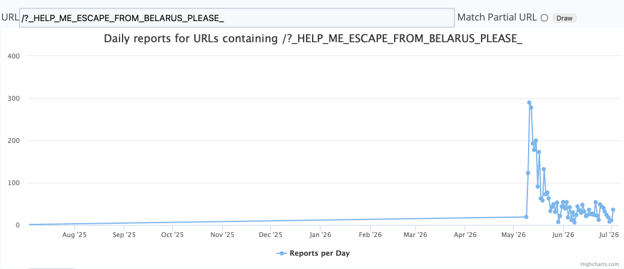
Further research showed that this bot was first reported to ISC in May 2026. The number of reports peaked shortly after the first report before a sharp drop and has remained steady since. [1]
I was unable to locate much more information about this bot other than a reddit thread on r/selfhosted describing the same requests hitting a Traefik reverse proxy. According to that thread, the user emailed the address embedded in the User-Agent and received a reply pointing to a page on a free web-hosting service. The page is a static HTML document with no scripts and it lays out what the bot is & why it exists.
The author, who identifies himself only as “Alex,” claims to be based in Belarus and writes that the bot is intentionally limited: no exploits, no command-and-control, no persistence. In his words, paraphrased and summarized from the page:
• The bot scans random IP addresses for open HTTP ports (80, 8000, 8080) and SSH ports (22, 2222).
• If it finds an open HTTP port it sends a single request (GET, CONNECT, or HEAD)
• If it finds an open SSH port it attempts a brute force with a small, fixed list of default credential pairs (admin:admin, root:root, etc.)
• It runs fully autonomously with no C2 channel; discovered IP/credential pairs are reported back to a loader only.
• It does not establish persistence, typically running from /tmp, and it is designed to self-terminate roughly six months after release.
• The stated purpose is to draw attention to conditions in Belarus. They describe it as a “performance piece,” saying they are not seeking funding and only asking for non-financial help leaving the country (job leads, advice, connections).
Disregarding the origin and supposed intent of the bot, this is a straightforward scan-and-brute-force bot and it should be treated like any other hitting a honeypot. The HTTP request is reconnaissance/fingerprinting that tells the operator a host is alive and reachable on that port. The risk is on the SSH side: any host reachable on TCP 22/2222 that still uses a default or weak credential pair is exposed, regardless of the creator’s stated intentions.
I want to give some healthy skepticism here rather than take the linked page at face value. I have no way to verify the age, location, or motive claimed on that page, whether the page itself is the full extent of the bot's behavior, or whether the “self-terminate after six months” and “no persistence” claims hold up under closer reverse engineering. Sob stories and appeals to sympathy are also a known social-engineering lever, and a URI designed to make analysts pause and read a web page rather than immediately blocklist an IP is an effective way to buy a scanner some goodwill. None of that changes the defensive posture: treat it as an untrusted, credential-guessing scanner.
[1] https://isc.sans.edu/weblogs/urlhistory.html?url=Lz9fSEVMUF9NRV9FU0NBUEVfRlJPTV9CRUxBUlVTX1BMRUFTRV8=
[2] https://isc.sans.edu/honeypot.html
[3] https://www.sans.edu/cyber-security-programs/bachelors-degree/
Disclosure: Claude was used for grammar and polish checks. No further use of generative A.I. was used in the creation of this post.
-----------
Guy Bruneau IPSS Inc.
My GitHub Page
Twitter: GuyBruneau
gbruneau at isc dot sans dot edu