
FortiBleed: 75,000 Fortinet Firewalls Compromised: Global Enterprises Exposed – Claim Your Ethical Disclosure
By Hudson Rock | infostealers.com

Fortinet firewalls and VPN gateways serve as the primary defensive perimeter for countless organizations worldwide. However, a massive new cyber espionage campaign has silently compromised these highly trusted devices on an unprecedented global scale.
Originally discovered by security researcher Volodymyr “Bob” Diachenko and subsequently analyzed by Hudson Rock, this dataset exposes a massive, automated operation. Threat actors successfully targeted 73,932 unique firewall URLs across 194 countries, resulting in 21,632 unique affected domains.
Attacker Methodology & Unprecedented Scale
According to Diachenko’s investigative report, this campaign is orchestrated by a multi-operator, Russian-speaking cybercriminal group. The operation’s footprint is staggering: the attackers executed an estimated 1.16 billion credential attempts against over 320,000 FortiGate targets, alongside an additional 2.1 billion brute-force attempts directed at over 160,000 MSSQL servers.
The group’s methodology goes beyond simple credential reuse. They actively intercept SSL VPN authentication hashes and crack them using a massive, dedicated 45-GPU cluster managed via Hashtopolis. Once the perimeter is breached, the operators systematically pivot directly into internal Active Directory environments to establish deep network persistence.
This aggressive methodology has led to severe, real-world consequences. Diachenko’s research confirmed full network compromises at multiple organizations across Japan, Taiwan, Vietnam, Iraq, and Turkey. Most alarmingly, this includes a Turkish NATO defense contractor from which classified defense documents were successfully exfiltrated by the group.
High-Profile Victims Identified
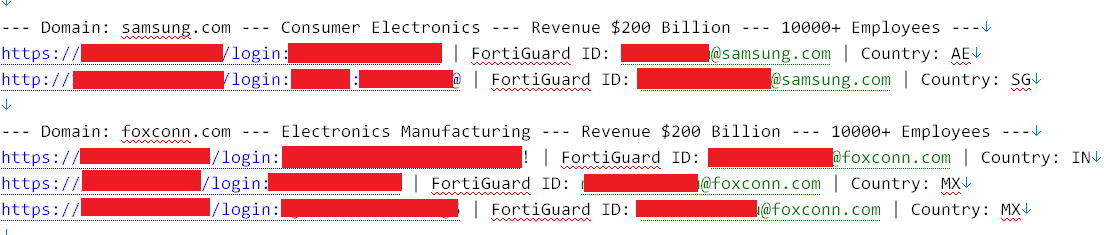
The scale of this breach touches nearly every sector of the global economy, sparing no industry. The threat actors have built a verified database of working credentials for some of the largest enterprises on the planet.
Among the victims discovered in this dataset are massive multinational corporations, including:
- Foxconn
- Samsung
- Comcast
- Siemens
- Lenovo
- PwC
- Accenture
- Oracle
- …and thousands of others, including major government entities and critical infrastructure providers.
Inside the Data: The Attackers’ Logs
When examining the attacker infrastructure, it becomes clear how systematic and devastating this campaign is. The attackers maintained highly organized logs of successful breaches.
The Illusion of Password Complexity
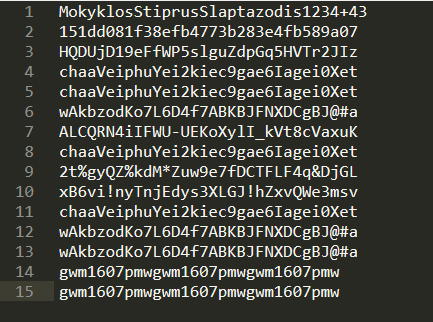
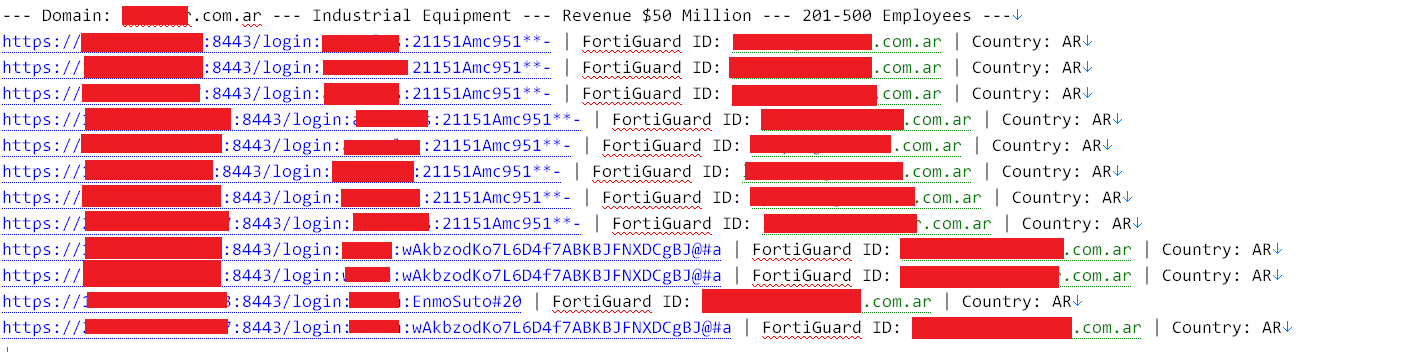
A particularly alarming detail from this dataset is the high volume of extremely complex passwords that were successfully compromised. IT departments frequently lean on rigid password complexity rules as their main line of defense.
However, complexity is completely neutralized when passwords are recovered in plaintext. Whether threat actors leverage specific device exploits that expose plaintext credentials, or utilize databases previously harvested by Infostealers, a 20-character complex string is just as vulnerable as a simple one. If the attackers are recycling known plaintext credentials to bypass perimeters, complexity policies offer no protection.
Recommended Mitigation Steps
To secure your network against this specific vector, we strongly recommend the following immediate actions:
- Force Credential Rotation: Immediately reset all passwords associated with Fortinet VPN and admin interfaces. As demonstrated, password complexity is not a substitute for rotation if the credentials have been leaked.
- Enforce Strict MFA: Ensure Multi-Factor Authentication is universally applied to all external gateways, effectively neutralizing the threat of stolen plaintext passwords.
- Audit Gateway Logs: Review Fortinet access logs for anomalous login locations, unexpected administrative sessions, or unusual traffic volumes passing through the firewall.
- Monitor for Stolen Credentials: Proactively monitor employee and third-party vendor credentials against threat intelligence databases to catch compromised passwords before they are weaponized against your perimeter.
 Free Look-Up Tool for Affected Organizations
Because of the critical nature of this massive campaign, Hudson Rock is committed to performing ethical disclosures for affected organizations.
We have launched a dedicated portal where companies can verify if their domains are part of this compromised dataset. Following confirmation of impact, organizations can reach out directly through the tool to receive a full ethical disclosure regarding their exposure.
Search Your Domain Now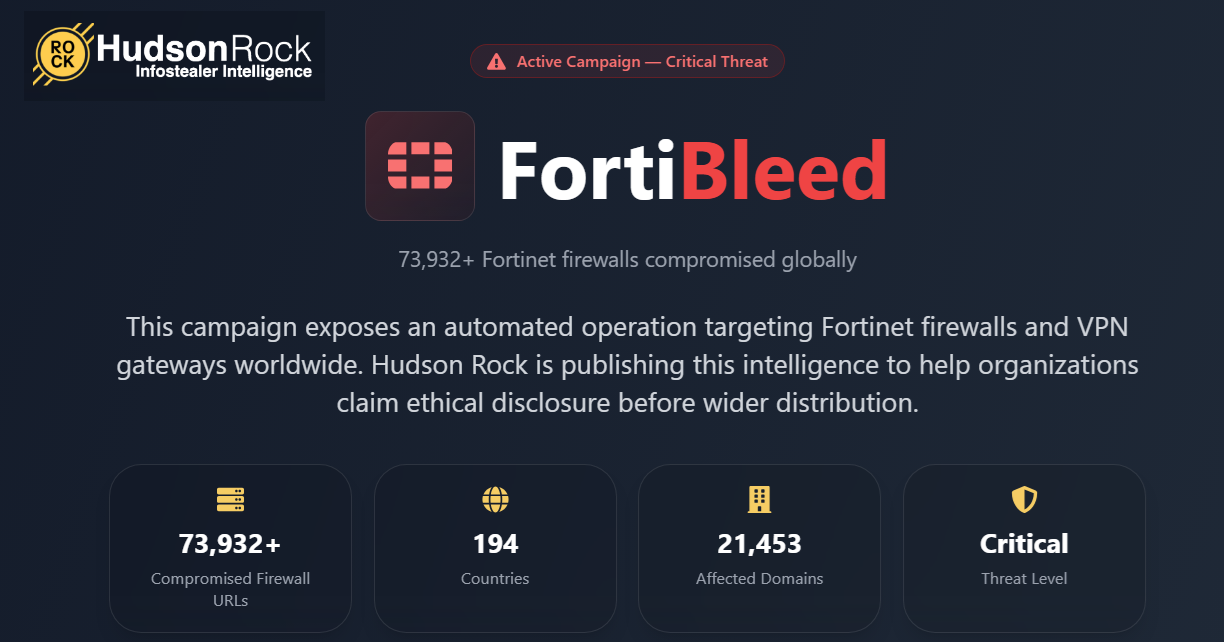
The free Hudson Rock lookup portal for affected organizations.
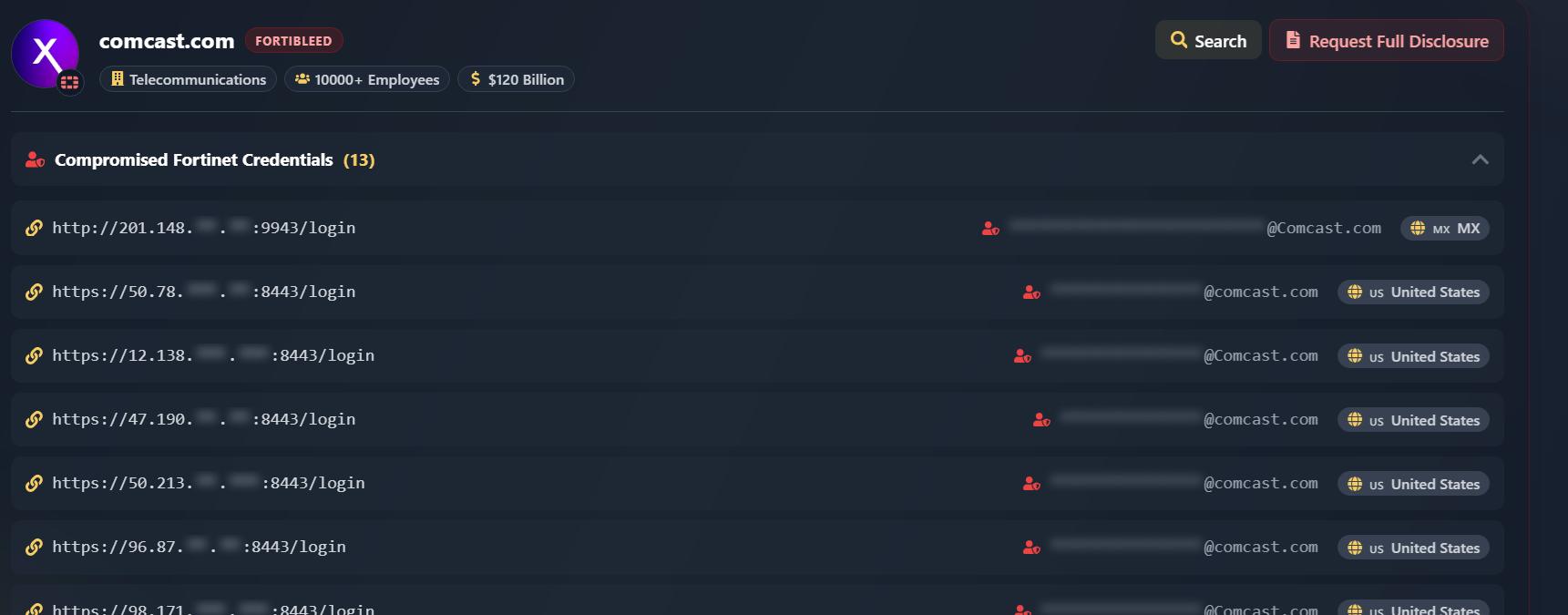
Example: Verifying if an organization like Comcast was compromised in the breach.
Global Scope: Top 30 Affected Countries
This campaign has a massive global footprint. Below are the top 30 countries impacted by this compromise, ranked by the number of breached devices:
 India (IN) 9,629
 United States (US) 6,352
 Taiwan (TW) 3,637
 Mexico (MX) 3,197
 Turkey (TR) 3,032
 Thailand (TH) 2,939
 Colombia (CO) 2,436
 Malaysia (MY) 2,066
 Chile (CL) 2,015
 United Arab Emirates (AE) 1,988
 Brazil (BR) 1,737
 South Korea (KR) 1,687
 Hong Kong (HK) 1,462
 Dominican Republic (DO) 1,413
 Italy (IT) 1,259
 Singapore (SG) 1,142
 France (FR) 1,116
 China (CN) 1,066
 Vietnam (VN) 1,038
 Puerto Rico (PR) 917
 Guatemala (GT) 878
 Spain (ES) 865
 Philippines (PH) 857
 Israel (IL) 851
 Canada (CA) 810
 Argentina (AR) 806
 South Africa (ZA) 771
 Panama (PA) 688
 Peru (PE) 627
 Ecuador (EC) 547
Top 30 Affected Industries & Services
Telecommunications and IT Services took the heaviest hits, but the attacker’s net was cast incredibly wide. Here is the breakdown of the top 30 compromised sectors:
Conclusion
This massive incident serves as a glaring reminder that exposed network gateways combined with reused or stolen credentials are an attacker’s dream. Relying on password complexity policies is not enough to secure environments against data points harvested by Infostealers.
Check if your company has been exposed today by using Hudson Rock’s Free Fortinet Look-Up Tool.
The post FortiBleed: 75,000 Fortinet Firewalls Compromised: Global Enterprises Exposed – Claim Your Ethical Disclosure appeared first on InfoStealers.