
FortiBleed 2.0: 75% of Breached Organizations Are Brand-New (Free Lookup Tool Available)
Following Hudson Rock’s landmark FortiBleed investigation, a massive second wave of 1,703 parsed FortiGate configurations extracted by threat actor “k0t” reveals what happens after initial firewall access: 36,964 cleartext SSL-VPN users, 1,937 decrypted Active Directory LDAP bind accounts, and conclusive forensic proof that 89.3% of “remediated” repeat victims left rogue super-admin backdoors wide open.
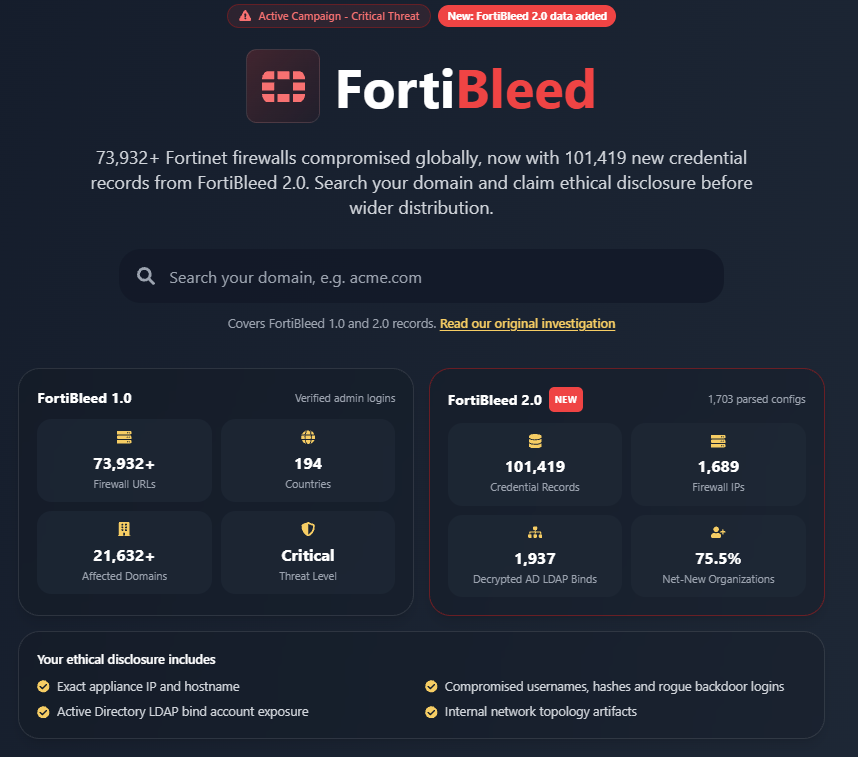
 Looking to check your organization right now? Skip ahead to verify your perimeter exposure at our free community portal.
- 01 Executive Summary & NyxLab Credit
- 02 Anatomy of the “k0t” Pipeline
- 03 FortiBleed 1.0 vs. 2.0 Comparison
- 04 The 89.3% Persistence Smoking Gun
- 05 Unmasking 54.8% of Hidden Victims
- 06 Internal Network Recon Blueprints
- 07 Mandatory Remediation Playbook
 Immediate Exposure Verification & Cavalier Integration
All 101,419 credential records, 1,248 verified corporate domains, and 1,689 compromised FortiGate IP addresses analyzed in this research have been indexed into Hudson Rock’s Cavalier cybercrime intelligence platform and integrated into our free community verification portal. Organizations can immediately query their domains to determine if their perimeter appliances, VPN users, or Active Directory bind accounts were exposed.
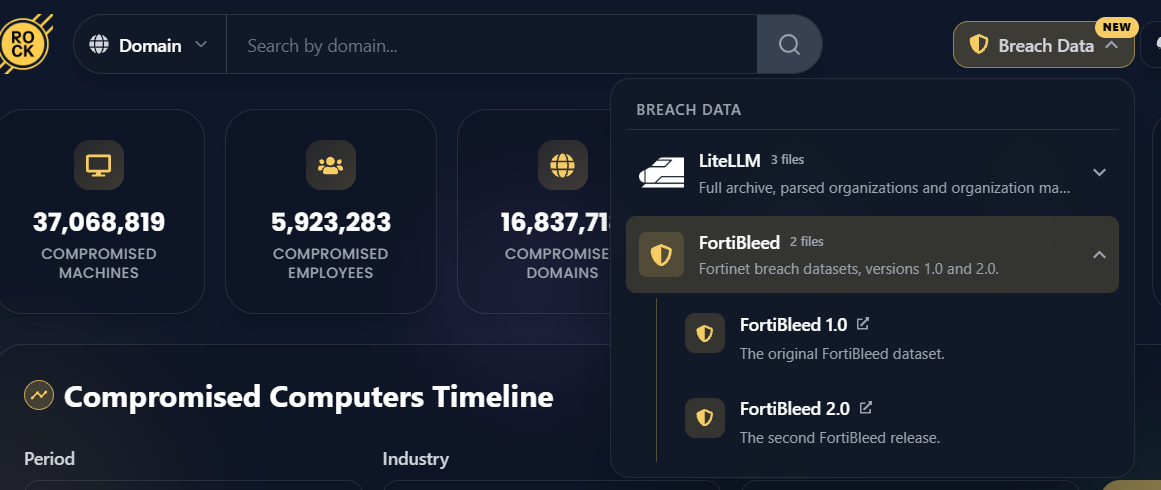
Furthermore, the raw FortiBleed 2.0 dataset, along with the original FortiBleed 1.0 dataset and the LiteLLM breach data, are already available for direct download to Hudson Rock’s Data Enrichment customers through our platform Cavalier under the new Breach Data hub.
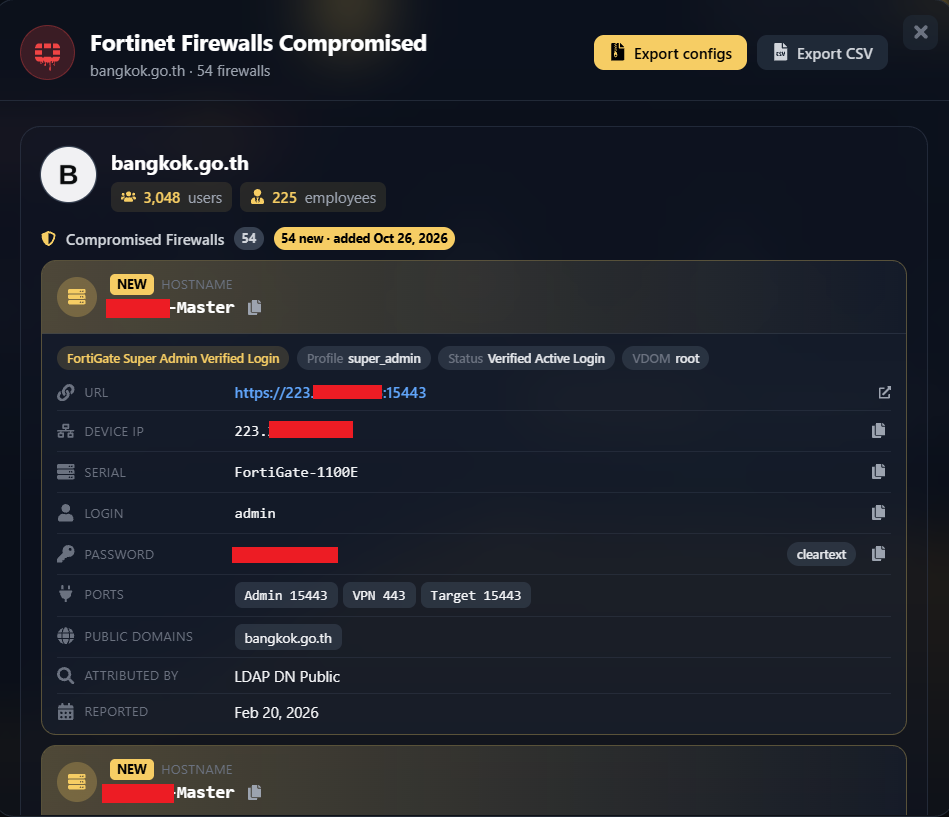
What impacted organizations receive in their ethical disclosure:
- Exact Appliance IP & Hostname: Direct mapping to your perimeter devices.
- Compromised Usernames & Hashes: Affected System Admin accounts, rogue backdoor logins (fgtsecure, etc.), and decrypted local VPN users.
- Active Directory LDAP Bind Account Exposure: The specific service account name and cleartext password dumped from your firewall.
- Internal Network Topology Artifacts: Specific internal subnets, Domain Controllers, and backup systems identified in the configuration file.
For Hudson Rock Data Enrichment Customers: The full raw FortiBleed 2.0 dataset, alongside the original FortiBleed 1.0 dataset and the LiteLLM breach archive, are already live and available for direct access and download inside Hudson Rock’s Cavalier platform under the Breach Data menu.
1. Executive Summary & Research Attribution
Earlier in 2026, Hudson Rock uncovered the original “FortiBleed” leak, an unprecedented exposure of nearly 75,000 compromised Fortinet FortiGate firewall records (73,931 verified super_admin login pairs across 69,055 unique hosts) linked to the critical zero-day authentication bypass vulnerability CVE-2026-24858 (CVSS 9.4) in FortiOS, FortiProxy, and FortiSwitchManager. That initial disclosure showed how threat actors weaponized malicious FortiCloud SSO accounts to mass-harvest administrative credentials and create rogue management accounts across global enterprise perimeters.
Today, Hudson Rock researchers are releasing a deep-dive forensic analysis into FortiBleed 2.0: a massive post-exploitation dataset consisting of 1,703 fully parsed FortiGate configuration dumps (representing 1,689 unique firewall IP addresses and 101,419 extracted credential records).
 Intelligence Credit: NyxLab
Hudson Rock extends special credit and gratitude to security researcher NyxLab for publishing foundational technical research tracking the threat actor behind the automated extraction pipeline. We strongly recommend reading NyxLab’s full technical blog post: “Tracing k0t: Inside a Global FortiGate Compromise Affecting Over 2,000 Organizations” for additional background on the actor’s operational infrastructure.
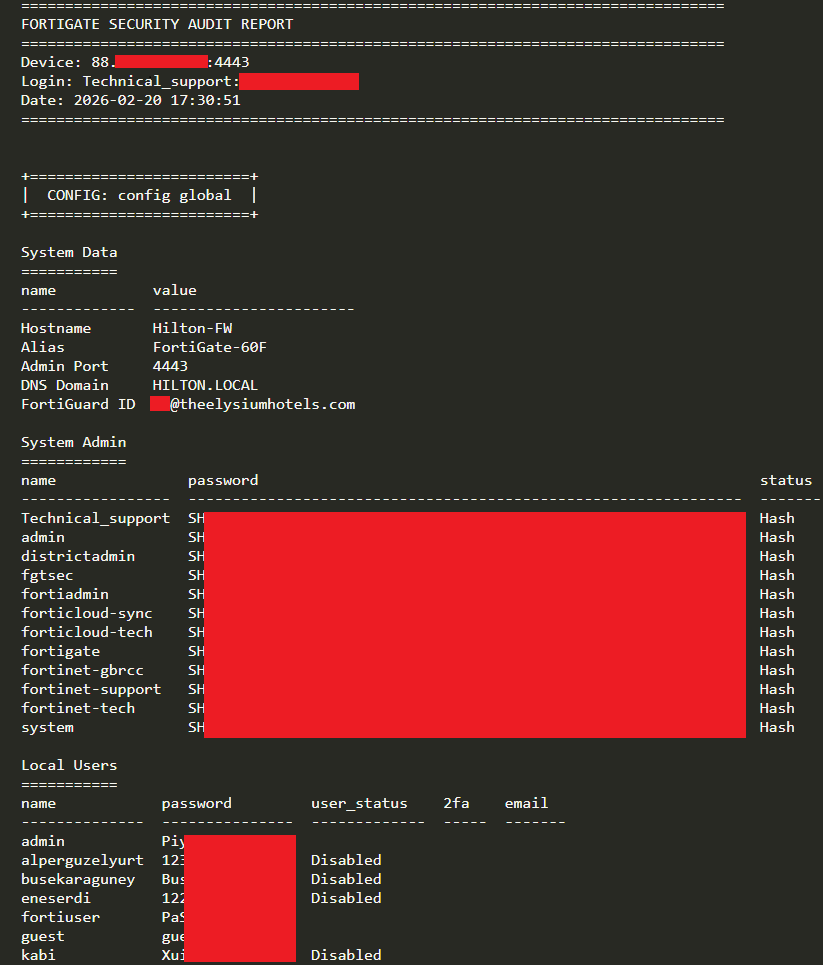
While FortiBleed 1.0 was a perimeter verification list confirming that an attacker held a working super_admin login and scraping surface metadata (FortiGuard ID, SNMP Contact, and DNS Domain), the FortiBleed 2.0 dataset exposes the complete internal anatomy of every breached appliance. Using custom Python automation, the threat actor known as “k0t” (affiliated with the 1011.team syndicate and acting as a supplier to the Qilin and The Gentlemen ransomware operations) logged into each compromised FortiGate, downloaded its raw configuration backup, and systematically reversed FortiOS’s symmetric password encryption.
Architectural Indictment: The FortiOS Symmetric ENC Flaw
FortiBleed 2.0 highlights a critical architectural vulnerability in FortiOS: while administrator passwords are properly hashed using SHA-256 (SH2) or PBKDF2 (PB2), SSL-VPN local user passwords and Active Directory LDAP bind secrets are stored using reversible symmetric encryption (ENC …) derived from a static key compiled directly into the FortiOS binary. This design choice turns any offline configuration backup into an instant cleartext credential harvest for attackers.
Parsed across 1,703 FortiGate configuration dumps from 1,689 unique firewall IPs.
Decrypted directly from FortiOS reversible ENC ciphertext blobs via hardcoded keys.
Decrypted Active Directory service & Domain Admin accounts out of 2,163 LDAP configs.
729 of 965 primary domains (and 914 of 1,248 total domains) were NOT in the first leak.
2. Anatomy of the “k0t” Post-Exploitation Pipeline
Forensic artifacts inside the leaked configuration dumps show how k0t industrialized the transition from FortiGate Perimeter Access to Full Active Directory Domain Compromise. Rather than manually inspecting firewalls, the actor built a multi-stage automation pipeline:
- Automated Config Extraction & Cryptographic Reversal (forti_parse.py): While FortiOS hashes System Admin passwords using SHA-256 (SH2) or PBKDF2 (PB2), it stores SSL-VPN Local User passwords, Active Directory LDAP bind passwords, HA Cluster keys, and SMTP relay credentials using reversible symmetric encryption (ENC …) derived from a static key compiled into the FortiOS binary. k0t’s parser automatically decrypted 40,573 cleartext passwords across the 1,703 appliances.
- Automated SSL-VPN Tunneling (vpn_checker.py / OpenConnect): Using the decrypted Local Users table and the verified super_admin credentials, the actor spun up headless openconnect SSL-VPN sessions into the victim’s internal corporate LAN.
-
Active Directory Harvest via NetExec (nxc):
Once inside the VPN tunnel, the toolchain immediately targeted the exact internal Domain Controller IP addresses listed in the firewall’s LDAP configuration table.
Critical Anti-Pattern Discovered: Many IT administrators configured actual Domain Admin or highly privileged service accounts as the LDAP bind user to save time during setup. When k0t decrypted these bind credentials, they instantly obtained full Active Directory domain query rights to dump NTDS.dit and deploy ransomware.
3. Head-to-Head Comparison: FortiBleed 1.0 vs. FortiBleed 2.0
A critical question for defenders and CISOs is whether the FortiBleed 2.0 dataset is simply a subset of the original FortiBleed 1.0 leak previously reported by Hudson Rock, or whether it represents net-new compromises.
Hudson Rock researchers performed a programmatic cross-correlation between all 73,931 credential lines (spanning 69,055 unique hosts and 22,029 domains) in FortiBleed 1.0 and all 101,419 credential records (spanning 1,689 unique IPs and 1,248 verified corporate domains using strict identity fields) in FortiBleed 2.0. The findings prove that over half of the compromised firewalls (54.7%) and three-quarters of the identified victim organizations (75.5%) are completely net-new.
| Forensic Metric | Original Leak (FortiBleed 1.0) | New “k0t” Dump (FortiBleed 2.0) | Overlap & Net-New Intelligence Delta |
|---|---|---|---|
| Total Credential Records | 73,931 (Admin logins only) | 101,419 (Admin + VPN + LDAP + HA + SMTP) | +100,895 net-new credentials never exposed in the first leak |
| Unique Firewall Hosts / IPs | 69,055 unique hosts | 1,689 unique firewall IPs (from 1,703 files) | 924 IPs (54.7%) are net-new devices; 765 IPs (45.3%) appear in both datasets |
| Primary Victim Organizations | 22,029 domains (FortiGuard ID / DNS) | 965 primary corporate domains | 729 organizations (75.5%) are brand-new; 236 (24.5%) overlap |
| Verified Corporate Domains (Strict Union) | 21,992 (excluding freemail providers) | 1,248 verified domains (Primary + FortiGuard + User Emails) | 914 corporate domains (73.2%) are brand-new; 334 (26.8%) overlap |
| Verified Super-Admin Logins | 73,931 (IP:Port/login:user:pass) | 1,672 verified cleartext admin logins | 906 on net-new IPs; 766 on the 765 overlapping firewall IPs |
| SSL-VPN / Local User Accounts | 0 (Not captured) | 83,414 (36,964 cleartext, 10,700 ENC, 35,750 LDAP-linked) | 100% net-new credential category enabling instant VPN infiltration |
| Active Directory LDAP Binds | 0 (Not captured) | 2,163 (1,937 decrypted cleartext AD accounts) | 100% net-new category granting direct internal AD domain queries & takeover |
| System Admin Entries & Hashes | 0 (Not captured) | 13,786 (10,376 SH2, 2,676 PB2, 316 AK1, 418 other/SSO) | Exposes every co-existing administrator and rogue backdoor account on the appliance |
| HA Cluster & SMTP Relay Creds | 0 (Not captured) | 384 (208 HA Cluster + 176 cleartext SMTP) | Exposes 176 corporate Microsoft 365 / Google Workspace / internal SMTP relay logins |
Breakdown of the 101,419 Extracted Credential Records by Secret Type
4. The Persistence Smoking Gun: What Happened on the 765 Overlapping Firewalls?
While the 924 net-new firewalls demonstrate the expanding reach of FortiGate exploitation, the 765 firewall IP addresses that appeared in both FortiBleed 1.0 and FortiBleed 2.0 provide an extraordinary forensic window into how enterprises failed to remediate CVE-2026-24858, and how multiple threat actors stacked rogue backdoors on the exact same appliances.
68.4% Never Rotated Passwords (524 Firewalls)
On 524 of the 766 verified admin logins across the overlapping IPs, k0t authenticated using the exact same administrator username and cleartext password that was publicly leaked in FortiBleed 1.0. Despite widespread public reporting and vendor advisories, more than two-thirds of repeat victims never rotated their compromised perimeter credentials.
31.6% Compromised via Secondary Backdoors (242 Firewalls)
On the remaining 242 overlapping firewalls (222 with a completely different username and password, and 20 with a different username sharing the same password), k0t logged in using a different super_admin account than the one listed in FortiBleed 1.0.
Why Did the Admin Account Change on 242 Firewalls?
In FortiBleed 1.0, those 242 firewalls were primarily accessed via default or first-wave rogue accounts such as admin (66x), Technical_support (22x), laboratorio (16x), forti-auth-tech (11x), and martinwong (7x). In FortiBleed 2.0, the actor authenticated to those exact same appliances using secondary rogue backdoor accounts, most notably:
- fgtsecure (106 overlapping appliances, typically paired with a standardized attacker password)
- admin (25 overlapping appliances where the previous leak used a different admin account)
- Technical_support (22 overlapping appliances)
- callcenter / Callcenter (17 overlapping appliances)
- fgtsec (11 overlapping appliances) & forticloud-sync (5 overlapping appliances)
 Forensic Finding: 89.3% Left the Old Compromised Admin Account Intact
Because FortiBleed 2.0 includes the full ### System Admin ### configuration table for every device, Hudson Rock researchers checked whether the original compromised admin account from FortiBleed 1.0 had been deleted on those 242 devices. In 216 out of 242 firewalls (89.3%), the old compromised admin account still existed inside the firewall’s System Admin table alongside the new rogue account. Only 26 firewalls (10.7%) actually deleted the original compromised administrator, yet they remained completely compromised because a second rogue super_admin backdoor (fgtsecure, forticloud-sync, or fgtsec) had been planted on the device prior to remediation.
5. The “Unmasking” Effect: How Deep Config Parsing Reveals 54.8% of Victims Hidden Behind MSSPs & Freemail
One of the most significant breakthroughs in analyzing FortiBleed 2.0 is resolving a major blind spot from FortiBleed 1.0. In the first leak, victim attribution relied almost entirely on the appliance’s registered FortiGuard ID email address.
In practice, thousands of enterprise FortiGate appliances are deployed and licensed by Managed Security Service Providers (MSSPs), regional telecommunications carriers, third-party IT integrators, or local administrators using personal freemail accounts or leaving the registration set to NONE. As a result, thousands of breached organizations in the first leak were misattributed to their telecom provider or hidden under generic freemail buckets.
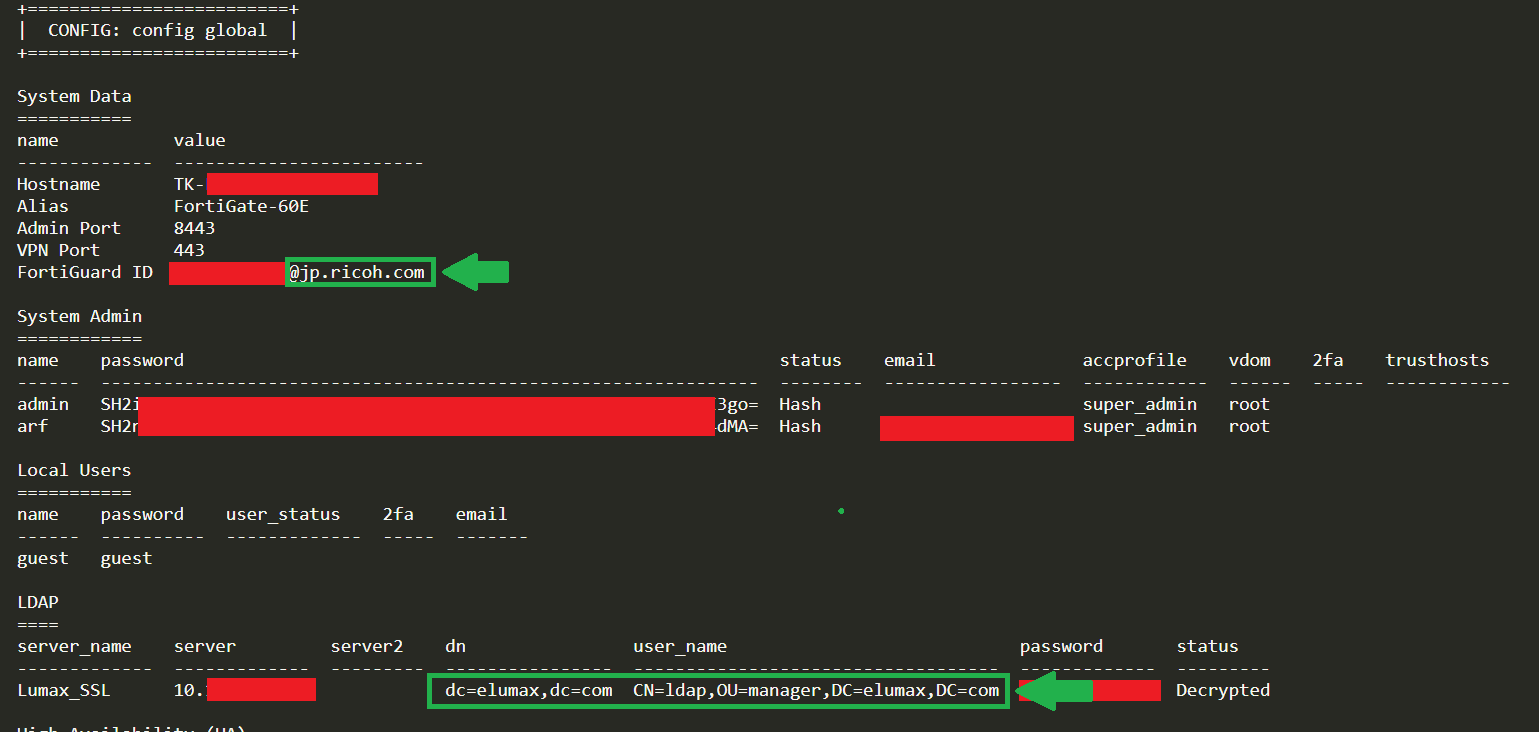
By building a multi-layered attribution engine that inspects the internal Active Directory LDAP Distinguished Name (DC=corp,DC=com), SSL-VPN Local User email addresses, and System DNS Domains before falling back to the FortiGuard ID, Hudson Rock researchers discovered that among the 765 overlapping firewalls, deep config parsing unmasked a completely different true victim organization on 419 appliances (54.8%).
| Firewall IP | Surface Attribution in FortiBleed 1.0 (FortiGuard ID) | True Victim Unmasked in FortiBleed 2.0 (LDAP / Users) | Why Surface Attribution Masked the Victim |
|---|---|---|---|
| 203.159.253.220 | nti.co.th (IT Integrator) | ovec.go.th / vec.go.th (Thailand Office of the Vocational Education Commission) | Appliance licensed by a third-party Thai IT contractor (nti.co.th), while internal LDAP (dc=ovec,dc=go,dc=th) and 600+ local users belong to the Ministry of Education agency. |
| 211.75.64.189 | jp.ricoh.com (Ricoh Japan MSSP) | elumax.com (Elumax Corporation) | Managed firewall registered under Ricoh’s security operations email ([redacted]@jp.ricoh.com); internal LDAP table reveals the customer’s Active Directory domain. |
| 49.229.69.162 | dataworkconnect.com (IT Vendor) | payap.ac.th (Payap University) | Registered to an external IT vendor’s email, while internal LDAP bind points directly to DC=ads,DC=payap,DC=ac,DC=th. |
| 20.206.216.37 & .184 | NONE (Unregistered Cloud Appliance) | marubeni-trans.com (Marubeni Logistics / Enterprise Hub) | Zero FortiGuard registration on the HA pair; unmasked via internal LDAP servers (DC=marubeni-trans,DC=com) and internal FQDN routing objects. |
6. Beyond Credentials: Turnkey Internal Network Blueprints for Ransomware Affiliates
Even when an organization enforces Multi-Factor Authentication (MFA) on standard employee SSL-VPN accounts (though our telemetry shows that over 98% of the 83,414 extracted Local User profiles had Two-factor: disable), the leaked configuration files hand ransomware operators a complete blueprint of the internal network via the ### Policy & Objects -> Addresses ### and ### Static Routes ### tables.
Before initiating a single network scan that might trigger an Endpoint Detection and Response (EDR) alert, ransomware affiliates using k0t’s dumps already know the exact internal IPv4 addresses, subnets, and VLAN interfaces of the victim’s crown-jewel infrastructure:
- Backup & Disaster Recovery Servers: Explicit firewall address objects naming Veeam_Backup, NAS_Synology, Qnap_Backup, and Rubrik_Cluster alongside their exact internal IP addresses.
- Virtualization & Hypervisor Management: Direct mappings to vCenter_Server, ESXi_Host_01, NutaniX_CVM, and Proxmox management interfaces.
- Identity & Core Enterprise Infrastructure: Internal IP addresses for primary and secondary Active Directory Domain Controllers (DC01, DC02), Microsoft Exchange servers, SAP ERP databases, and internal jumpboxes.
7. Mandatory Remediation Playbook: Why Resetting Your Admin Password Is Not Enough
Our forensic comparison between FortiBleed 1.0 and FortiBleed 2.0 proves that simply patching FortiOS or rotating the primary admin password leaves organizations completely exposed to re-compromise. Security teams must execute a comprehensive four-tier eradication workflow:
1. Audit & Purge Rogue super_admin Accounts
Inspect config system admin across all FortiGate appliances. Immediately remove unauthorized accounts planted during automated exploitation waves, including:
fgtsecure, fgtsec, Technical_support, forticloud-sync, forti-auth-tech, callcenter, my_admin, districtadmin, ftadm1n, and super_admin.
2. Rotate Active Directory LDAP Bind Accounts
Because FortiOS stores config user ldap bind passwords using reversible symmetric encryption, assume every AD service account configured on your firewall has been decrypted in cleartext.
Immediately rotate the password of the AD bind user in Active Directory, strip any excessive privileges (such as Domain Admins membership), and restrict it to read-only LDAP queries.
3. Reset All Local SSL-VPN Accounts & Enforce MFA
Every user entry in config user local had its ENC password blob extracted and decrypted. Force a password reset for all local VPN users, migrate authentication to SAML/OIDC with hardware-backed MFA, and disable unused local accounts.
4. Rotate HA Cluster, RADIUS & SMTP Secrets
Rotate High Availability (config system ha) encryption passwords, RADIUS shared secrets, and any corporate SMTP relay credentials configured under config system email-server, as 176 cleartext SMTP accounts were harvested in this dump alone.
 Verify Your Exposure in Hudson Rock Cavalier & Our Free Fortinet Portal
To assist defenders, CERTs, and enterprise SOC teams globally, Hudson Rock has integrated the entirety of the 101,419 credential records and 1,248 verified corporate domains from FortiBleed 2.0, alongside the original FortiBleed 1.0 dataset, into Hudson Rock’s Cavalier platform and our free public lookup utility. Furthermore, the raw FortiBleed 2.0, FortiBleed 1.0, and LiteLLM datasets are already available for direct download to Hudson Rock’s Data Enrichment customers inside Cavalier.
The post FortiBleed 2.0: 75% of Breached Organizations Are Brand-New – Claim Your Ethical Disclosure appeared first on InfoStealers.